
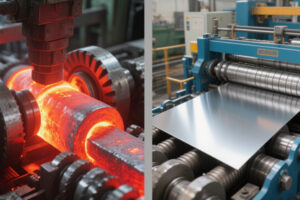
Cold Rolled VS Hot Rolled
Hot-rolled steel sheet, mechanical properties are far inferior to cold processing, also inferior to forging processing, but has better toughness and ductility. Cold-rolled steel sheet...
Choosing between cold rolled and hot rolled steel is one of the most critical decisions in metal procurement. While both processes result in versatile steel products, the manufacturing temperature fundamentally alters their mechanical properties, surface finish, and dimensional accuracy. Explore our curated insights to understand which steel type is best suited for your specific engineering and budgetary requirements.
The primary distinction between hot rolled and cold rolled steel lies in the temperature at which they are processed. Hot rolling occurs at temperatures above the steel’s recrystallization point (typically over 1,700°F), making the material easier to shape. Conversely, cold rolling is performed at room temperature, which increases the steel’s strength through strain hardening. In this section, Runfei’s technical experts break down how these two processing methods impact the final product’s performance.
Hot rolled steel (HRS) is often the preferred choice when precise shapes and tolerances are not the primary concern. Because it is cooled at room temperature after processing, it is free from internal stresses that can arise during quenching or work-hardening.
Surface: It typically has a scaly, grey finish (mill scale).
Tolerance: Slightly looser dimensional accuracy due to shrinkage during cooling.
Applications: Ideal for structural components, railroad tracks, and I-beams where strength is needed at a lower cost.
Cold rolled steel (CRS) is essentially hot rolled steel that has undergone further processing to achieve more exact dimensions and a smoother surface.
Surface: Smooth, oily, or polished appearance, perfect for painting or plating.
Strength: Up to 20% stronger than hot rolled steel due to the cold-working process.
Applications: Essential for precision parts, automotive components, home appliances, and furniture where aesthetics and accuracy are paramount.
Deciding between the two often comes down to the balance between “Form” and “Function.” If your project requires tight tolerances and a premium visual appearance, cold rolled steel is the industry standard. However, for large-scale structural projects where cost-efficiency is the priority, hot rolled steel remains the most economical solution. Our knowledge base articles provide detailed price trend analysis and technical comparisons to help you optimize your supply chain.
Q: Is cold rolled steel more expensive than hot rolled steel?
A: Yes. Because of the additional processing steps, improved surface quality, and tighter tolerances, cold rolled steel typically carries a higher market price than hot rolled steel.
Q: Does cold rolled steel rust faster?
A: Both will rust if exposed to moisture. However, because cold rolled steel has a smoother surface, it is easier to apply protective coatings (like oil, zinc, or paint) to prevent oxidation compared to the rougher surface of hot rolled steel.
Q: Can I use hot rolled steel for precision machining?
A: It is possible, but not recommended if high precision is required. Hot rolled steel may warp or deform slightly when machined due to the release of internal stresses, whereas cold rolled steel is more stable.

Our mission is to be the pioneer of product, cost solution and service concept in steel industry chain.