
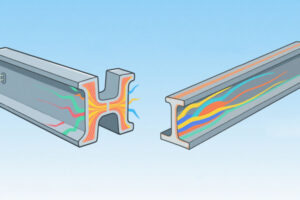
What is the Difference Between an H-Beam and I-Beam?
The knowledge of the day! Do you know how H-beams and I-beams are used differently? Keep reading and we will help you answer this important question. In...
Optimize your structural designs with Runfei’s Shape Steel Knowledge Hub. Also known as section steel or profile steel, these materials are the structural pillars of modern infrastructure. Explore our technical library covering standard steel angles, channels, and specialized profiles. Whether you are designing industrial frameworks or residential supports, stay updated with the latest manufacturing standards and material selection guides for global construction projects.
Shape steel, or section steel, refers to steel products with specific cross-sectional shapes designed for load-bearing and structural rigidity. In this category, Runfei provides deep-dives into the geometric properties that make these shapes essential for engineering. From hot-rolled sections to cold-formed profiles, understanding the moment of inertia, radius of gyration, and section modulus is key to selecting the right steel for bridges, buildings, and heavy machinery.
Our knowledge base categorizes the diverse range of shape steel to help you find the exact profile for your application:
Steel Angles (L-Sections): Available in equal and unequal leg lengths, these are fundamental for bracing and structural reinforcements.
Steel Channels (C & U Sections): Widely used for purlins, vehicle frames, and building wall supports due to their excellent bending resistance.
Steel Tees (T-Sections): Often utilized as load-bearing members in trusses or as structural transitions in steel-to-concrete connections.
To ensure safety and compatibility in global markets, Runfei tracks the latest updates in international steel standards. Our articles compare:
ASTM A36 & A572: The standard for structural shapes in the American market.
EN 10025 (S235JR, S355JR): The most common European standards for hot-rolled section steel.
JIS G3101 (SS400): General structural steel standards popular in Asian markets.
We help buyers understand grade equivalencies to ensure every project meets local building codes while maintaining cost-efficiency.
The steel industry is evolving toward lighter, high-strength sections that contribute to sustainable construction. In our news section, we discuss how the use of high-strength low-alloy (HSLA) steels in shapes like angles and channels can reduce total material weight without compromising safety. Stay informed on how these innovations help reduce transportation costs and the overall carbon footprint of large-scale industrial projects.
Q: What is the difference between hot-rolled and cold-formed shape steel?
A: Hot-rolled shapes are formed at high temperatures and are ideal for large structural members. Cold-formed shapes are processed at room temperature, allowing for thinner walls and more complex profiles with high dimensional precision.
Q: Which grade is best for steel channels used in outdoor construction?
A: S235JR and ASTM A36 are standard for general use. However, for outdoor or corrosive environments, we recommend using galvanized shape steel or ZAM-coated profiles to extend service life.
Q: Does Runfei provide custom-cut lengths for steel angles and channels?
A: Yes. In addition to our knowledge sharing, we provide processing services including precise cutting-to-length, drilling, and surface shot-blasting to provide ready-to-install sections for your construction site.

Our mission is to be the pioneer of product, cost solution and service concept in steel industry chain.