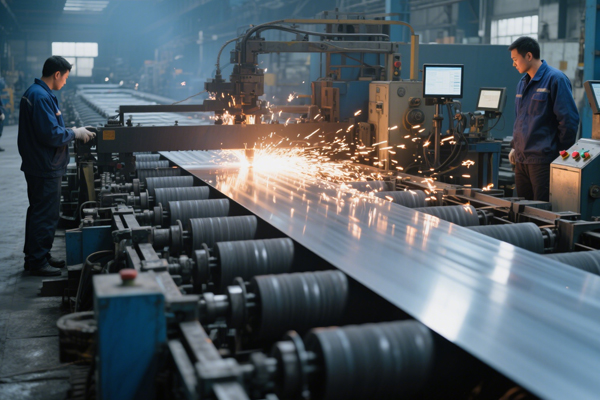
Hot rolled heavy plates (typically defined as steel plates with a thickness ≥ 4 mm, up to 400 mm for special applications) are core structural materials in bridge construction and storage tank fabrication, owing to their high strength, excellent weldability, and stable structural performance. Below is a detailed breakdown of their applications, material requirements, and technical characteristics in these two fields:
I. Applications in Bridge Construction
Hot rolled heavy plates serve as the load-bearing backbone of bridges, used in critical stress-bearing components that determine the bridge’s safety, durability, and service life.
1.Main Load-Bearing Core Components (Main Girders, Webs, Flange Plates)
Selected Steel Grades: Domestic bridge steels complying with GB/T 714-2015, such as Q355B, Q355q, Q370q, Q420q; international standards including ASTM A709 (USA) and EN 10025-5 (EU), such as A709 Gr.50, S355J2G3.
Reasons for Selection:
- Yield strength matching load requirements: Low-alloy high-strength steels like Q355 (yield strength 355MPa) and Q370q (370MPa) can reduce plate thickness and structural dead weight while withstanding dynamic and static loads such as vehicle traffic and wind, making them suitable for long-span bridge designs.
- Excellent low-temperature toughness: Bridges need to adapt to various climates. Such steels have an impact absorption energy of ≥ 27J (≥ 34J for some grades) at -20℃/-40℃, preventing brittle fracture in low-temperature environments, especially applicable to cold regions.
- Superior weldability: Main load-bearing components require on-site splicing and welding. The carbon equivalent (CEV) of these steels is controlled below 0.45%, minimizing cold cracks and porosity during welding and ensuring joint strength and structural integrity.
- Special attribute of “q” mark: The letter “q” is an exclusive code for bridge steels. These steels undergo targeted composition optimization (such as reducing sulfur and phosphorus content, adding vanadium-titanium microalloys), exhibiting outstanding fatigue resistance to withstand fatigue damage caused by repeated vehicle loads.
2. Bearing Base Plates and Stiffeners
Selected Steel Grades: Q355B or Q355B (with local wear-resistant layer).
Reasons for Selection:
- Bearing base plates transfer loads from main girders to piers, requiring moderate strength and good pressure-bearing capacity. The Q355 series steels meet these requirements and are more cost-effective than high-grade bridge steels.
- Stiffeners mainly enhance local rigidity and do not require extremely high strength. Q355B offers better economy and formability, and its weldability is compatible with the main girder steel (Q355q), preventing joint performance incompatibility.
3. Wear-Resistant Pads for Expansion Joints
Selected Steel Grades: NM400, NM450 wear-resistant steels (GB/T 24186-2022).
Reasons for Selection:
- Expansion joints withstand repeated friction and impact from vehicle tires and expand/contract with temperature changes, with core requirements for wear resistance and certain impact toughness. NM series wear-resistant steels have a hardness of 400-480HBW, and their wear resistance is 3-5 times that of ordinary structural steels, extending the service life of expansion joints.
- NM400/NM450 undergo quenching and tempering treatment, with an impact toughness of ≥ 20J, capable of resisting vehicle impact and avoiding brittle fracture. Meanwhile, designed to have basic weldability (preheating required), they can be welded to the main girder steel (Q355q).
4. Bridge Components in Coastal/Corrosive Environments (Abutments, Guardrails)
Selected Steel Grades: Q355NH, Q460NH weathering steels (GB/T 4171-2008).
Reasons for Selection: Weathering steels form a dense oxide film on the surface by adding alloys such as copper, chromium, and nickel. Their corrosion resistance is 2-8 times that of ordinary carbon steel, reducing corrosion of components caused by coastal salt spray and industrial atmosphere, lowering long-term maintenance costs, and eliminating the need for complex additional anti-corrosion coatings.
II. Applications in Storage Tank Fabrication
Hot rolled heavy plates are the primary material for atmospheric storage tanks (e.g., crude oil, chemical liquid tanks) and pressure storage tanks (e.g., liquefied petroleum gas, liquid ammonia tanks), where sealing, corrosion resistance, and pressure-bearing capacity are critical.
1. Atmospheric Liquid Storage Tanks (Crude Oil, Water, Ordinary Chemical Liquids)
(1) Tank Walls, Roofs, and Bottoms (Main Structures)
Selected Steel Grades: Q235B (carbon steel), Q355R (low-alloy container steel, GB/T 713-2014).
Reasons for Selection:
- Q235B: Suitable for small-capacity (<1000m³), non-corrosive, normal-temperature and atmospheric-pressure storage tanks (such as clean water tanks, ordinary crude oil tanks). It is cost-effective, with excellent weldability and formability, meeting general sealing and load-bearing requirements.
- Q355R: The letter “R” is an exclusive code for container steels, suitable for large-capacity (≥10000m³) storage tanks or those with slightly pressurized media. With higher yield strength than Q235B, it can reduce tank wall thickness, lowering structural dead weight and material costs. Meanwhile, its extremely low sulfur and phosphorus content (S ≤ 0.015%, P ≤ 0.025%) ensures good plasticity of welded joints, preventing medium leakage due to welding cracks and achieving reliable sealing performance.
(2) Tank Bottom Edge Plates and Reinforcing Rings
Selected Steel Grades: Q355R or Q355B.
Reasons for Selection: Tank bottom edge plates bear the weight of the tank wall and medium pressure, being prone to local stress concentration. The Q355 series steels offer balanced strength and toughness, avoiding local deformation. Reinforcing rings enhance tank wall rigidity to resist wind loads and temperature-induced deformation. Q355B balances economy and formability, with weldability compatible with the tank wall steel.
2. Pressurized Storage Tanks (LPG, Liquid Ammonia, Low-Temperature Liquids)
Selected Steel Grades: 16MnDR, 09MnNiDR (low-temperature container steels, GB/T 713-2014), S355NL (European standard).
Reasons for Selection:
- Pressurized storage tanks withstand internal medium pressure (usually >0.1MPa), and some media (such as liquid ammonia, liquefied natural gas) need to be stored at low temperatures, with core requirements for low-temperature toughness and pressure-bearing capacity.
- 16MnDR (suitable for -20℃) and 09MnNiDR (suitable for -40℃) undergo low-temperature optimization treatment, with an impact absorption energy of ≥ 34J at -40℃, preventing brittle fracture of the container in low-temperature environments. Meanwhile, their yield strength of ≥ 345MPa meets pressure-bearing requirements, and welded joints are strictly controlled to ensure sealing and structural safety.
3. Powder/Wear-Resistant Medium Storage Tanks (Ore Powder, Cement, Gravel Slurry)
(1) Discharge Ports and Cone Sections (High-Wear Areas)
Selected Steel Grades: NM450, NM500 wear-resistant steels (GB/T 24186-2022).
Reasons for Selection: Powder media cause severe scouring wear when flowing through discharge ports and cone sections. The service life of ordinary container steel (Q355R) is only 1-2 years, while NM450/NM500 wear-resistant steels, with high hardness and excellent wear resistance, can extend the service life to 5-8 years. They are used in composite form with Q355R (wear-resistant layer + base material) to balance wear resistance and weldability (pure wear-resistant steel has poor weldability, and the base material ensures reliable connection with the tank wall).
(2) Wear-Resistant Layers on Inner Tank Walls
Selected Steel Grades: NM360/NM400 wear-resistant steels (in composite plate form).
Reasons for Selection: For large-area inner wall wear, NM series composite plates (3-5mm wear-resistant layer, 8-15mm Q355R base material) are adopted to resist powder scouring while controlling costs (pure wear-resistant steel is more expensive). The base material has good weldability, enabling seamless connection with the tank wall and ensuring sealing performance.
4. Storage Tanks for Corrosive Media (Sulfuric Acid, Brine, Sour Crude Oil)
Selected Steel Grades: Q355NH weathering steel, stainless steel composite plates (Q355R base material, 304/316L cladding layer).
Reasons for Selection:
- Mildly corrosive media (such as sour crude oil): Q355NH weathering steel resists corrosion through an oxide film, is more cost-effective than stainless steel, and suitable for large-area applications.
- Highly corrosive media (such as sulfuric acid, brine): Stainless steel composite plates combine the pressure-bearing capacity of the Q355R base material and the corrosion resistance of the stainless steel cladding layer, preventing medium leakage due to tank wall corrosion, while reducing costs by more than 50% compared to pure stainless steel storage tanks.