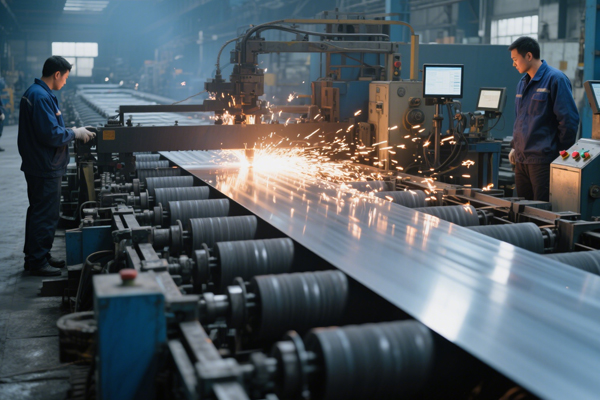
Introduction: The Critical Role of Receiving Inspection in Steel Procurement
Steel coils serve as the fundamental raw material for nearly all metal manufacturing industries, supporting the production of steel pipes, roofing sheets, and complete mounting system structures across global construction, automotive, and energy sectors. In international steel trade, receiving inspection acts as the final quality barrier before raw materials enter downstream production processes, effectively avoiding massive processing failures, cost losses, and project delays caused by unqualified steel materials. Whether customers purchase basic mild steel, high-precision cold rolled steel, or corrosion-resistant stainless steel, strict on-site inspection upon shipment arrival is indispensable for quality control.
As a globally reputable stainless steel manufacturer, Runfei Group has decades of experience in international steel export and quality management. The company implements full-process factory inspection and standardized ocean freight packaging to minimize inherent defects in the carbon steel product series and customized steel materials. Rigorous pre-shipment and receiving inspection protocols greatly reduce the risk of defective steel coils compromising the structural stability and service life of finished steel products, ensuring consistent quality for global downstream manufacturers.
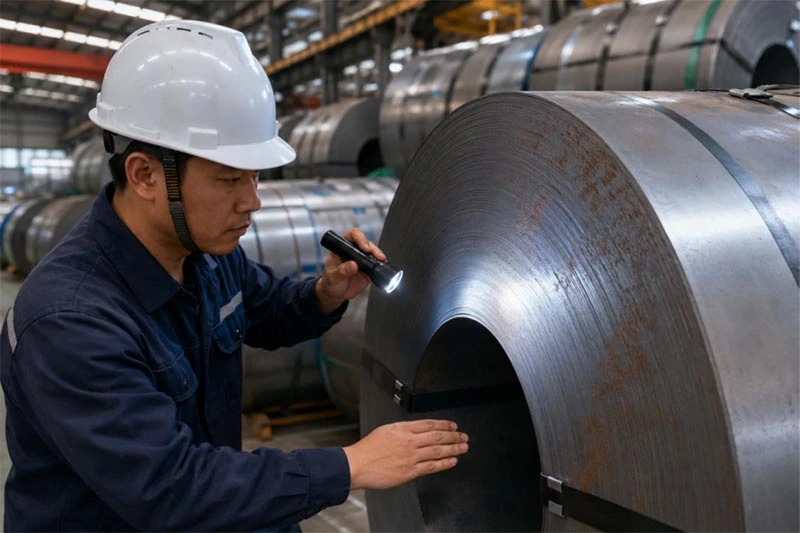
Defect 1: Surface Corrosion and Oxidation (Rust & White Rust)
Surface corrosion and oxidation are the most prevalent defects in steel coil cross-border transportation, primarily triggered by high humidity, temperature fluctuations, and long-distance ocean freight environments. Professional inspection can accurately distinguish harmless slight atmospheric oxidation from destructive deep corrosion, avoiding misjudgment of material quality and unnecessary losses. Different steel categories exhibit distinct corrosion characteristics, requiring targeted inspection standards.
For hot-rolled and carbon steel products, including black coil, hot–rolled steel, and pickled steel, surface oxidation and red rust formation are common during transit. Representative grades such as SPHC, Q235, A36 steel, and S235 are prone to loose oxide scale and scattered red rust spots when exposed to moist air for extended periods. Severe oxidation will form a thick, peeling scale that affects subsequent welding and surface treatment, while slight atmospheric oxidation can be removed through conventional pickling processing.
Coated steel coils have unique corrosion defect forms, dominated by white rust rather than red rust. Galvanized steel (GI steel), galvalume (GL steel), aluzinc steel, and ZAM steel rely on zinc and aluminum-zinc coatings for anti-corrosion performance. In humid and saline marine environments, the protective coating may react with water vapor and salt fog, forming white rust and partial coating peeling, which directly reduces the corrosion resistance.
Defect 2: Dimensional Deviations and Strict Steel Tolerances
Dimensional non-compliance is one of the core factors leading to downstream processing failures, including stamping distortion, bending cracking, and welding gaps. All steel coils must be inspected with precision measuring tools upon arrival to verify whether actual dimensions comply with international standards. Even minor thickness or width deviations can cause batch scrapping in high-precision manufacturing scenarios.
Cold–rolled steel supplier products feature ultra-thin and high-precision specifications with extremely strict tolerance requirements. Common cold-rolled grades such as SPCC steel, SPCD steel, SPCE steel, ST12 steel, ST14 steel, and DC01 steel to DC06 steel are widely used in precision hardware and automotive interior parts. Inspectors must strictly check thickness uniformity and flatness, as tiny dimensional deviations will lead to inconsistent stamping forming effects.
For hot-rolled steel coils, key inspection focuses on edge thinning and overall thickness consistency. Conventional specifications often have uneven edge thickness due to rolling process limitations. In addition, special-shaped steel materials require targeted inspection of pattern height and distribution uniformity, as irregular patterns will affect anti-slip performance and assembly accuracy of finished products.
Defect 3: Edge Defects and Lamination (Mechanical Failures)
Edge defects and internal lamination are fatal mechanical failures of steel coils, which directly cause strip breakage during slitting, annealing, and bending processing. These defects are mostly formed in the rolling and heat treatment process, with strong concealment, and will only be exposed during downstream deep processing, bringing huge production risks to manufacturers.
High-strength and high-hardness steel grades are more susceptible to edge brittleness and micro-cracks. Typical materials are widely used in spring and tool steel manufacturing. Inspectors need to focus on observing edge flatness and detecting tiny cracks, as these subtle defects will expand rapidly under high-stress processing conditions, resulting in material fracture.
Alloy structural steels and automotive high-strength steels have strict requirements on edge integrity. Grades such as 40CR, 42CRMO (equivalent to 42CrMo4), 50CRMO, QSTE380TM to QSTE500TM, SAPH440, and SPFH590 bear high tensile and bending loads in service. Edge burrs, cracks, and internal lamination will significantly reduce the mechanical properties of steel, leading to structural instability of automotive parts and engineering components.
Defect 4: Coating Adhesion and Paint Surface Faults (For Coated & Prepainted Coils)
Coated steel and prepainted steel coils rely on surface coatings to achieve long-term anti-corrosion performance, so coating quality inspection is a core link of steel coil receiving inspection. Unqualified coating adhesion, uneven thickness, and surface paint defects will directly shorten the service life of outdoor steel products and cause surface aging and peeling in advance.
Prepainted galvanized steel is widely used in building decoration and roofing engineering. During inspection, workers perform cross-cut and bending tests to assess paint film adhesion and carefully check the surface for missing coating, shrinkage holes, pinholes, and color differences. Unqualified adhesion will cause the paint layer to peel off after short-term outdoor use, losing its protective effects.
For the hot-dip galvanized steel series, including DX51D Z, DX52D Z, DX53D Z, DX54D Z, and DC51D Z to DC54D Z, common coating defects include air knife marks, zinc particle accumulation, and uneven zinc layer adhesion. These microscopic defects cannot be identified by the naked eye but require professional thickness gauges and adhesion testing tools. In addition, electro-galvanizing materials need standardized coating quality inspection to meet industrial application standards.
Defect 5: Shape Anomalies: Telescoping, Coil Breaks, and Center Buckles
Shape anomalies are typical geometric defects of steel coils formed during winding and transportation, which seriously affect unwinding efficiency and subsequent rolling processing. Such defects are mostly caused by uneven winding tension, violent transportation vibration, and insufficient tension leveling treatment, and are common in high-precision and high-value steel coils.
Telescoping and loose coil defects are frequent in silicon steel products. These high-precision electrical steels have strict requirements on coil shape, and telescoping deformation will cause uneven unwinding, directly affecting the production quality of electrical equipment and transformers.
Coil breaks refer to transverse fold marks on the steel surface, mostly appearing on hot-rolled soft steel without sufficient tension leveling. Wavy edge and center buckle defects will cause uneven flatness of steel coils, leading to deviation in stamping and forming of automotive steel, resulting in unqualified finished parts.
A Quick Reference: Inspection Checkpoints by Steel Applications
Different application scenarios correspond to differentiated steel quality standards and inspection priorities. The following table systematically sorts out key inspection parameters for mainstream steel categories, providing a quick and accurate reference for on-site receiving inspection personnel. All inspection indicators comply with ISO and ASTM international standards, ensuring inspection professionalism and accuracy.
| Steel Category | Representative Grades & Keywords | Key Inspection Parameters |
| Boiler & Pressure Vessel Steel | BOILER AND HIGH PRESSURE STEEL, Q245R, Q345R, Q370R, 16MNDR, 09MNNIDR, 12MnNiVR, A516 | Ultrasonic testing for internal defects, slag inclusion inspection, tensile strength and impact toughness verification, pressure resistance performance test |
| Wear & Abrasion Resistant Steel | ABRASION RESISTANT STEEL, NM400, NM450, NM500 steel | Surface hardness (HBW) detection, overall flatness calibration, edge crack inspection, wear resistance uniformity test |
| Weathering & Shipbuilding Steel | WEATHERING RESISTANT STEEL, CORTEN-A, SPA-H, A588, SMA490, SHIPBUILDING STEEL, EH36, EH40 steel | Compactness of rust layer, seawater corrosion resistance, coating thickness uniformity, low-temperature impact resistance test |
| Carbon Structural Steels | SAE 1006, S275JR, S355JR, S355J2+N, SS490, Q195, Q215, Q275, Q355, st37-2g, st37 steel | Yield strength verification, surface macroscopic scratch inspection, thickness tolerance deviation detection, surface flatness check |
| Medium & High Carbon Alloys | 50 steel, 45 steel, 60 steel, s50c, s45c, s55c, C60 steel, SAE 1045, AISI 1045, 50mn, 70mn, 45mn | Decarburization layer depth measurement, surface micro-crack detection, microstructure uniformity analysis, hardness consistency test |
Downstream Consequences: How Defective Coils Ruin Final Products
Negligent receiving inspection of steel coils will trigger a series of chain failures in downstream manufacturing, causing huge economic losses for processing enterprises. According to 2023–2024 global steel procurement audit data from SGS, more than 70% of steel product processing failures are traced back to unqualified raw steel coil defects, which are avoidable through strict receiving inspection.
In pipe manufacturing, defective steel coils directly affect the quality of steel pipes. Steel coils with edge cracks or excessive thickness deviation will cause high-frequency welding cracks in LSAW, SSAW, and ERW spiral welded tubes, reducing the pressure resistance of pipeline steel.
In the new energy industry, galvanized and coated steel coils are the main raw materials for solar power generation facilities. Steel coils with poor coating quality used to produce solar brackets will suffer from rapid coating aging and corrosion in outdoor environments. This greatly shortens the service life of the mounting system, endangering the structural safety of the entire photovoltaic power station and causing potential safety hazards for long-term operation.
Buying Smart: Sourcing Certified Steel Coils to Minimize Risks
The most effective way to avoid steel coil quality defects is to select qualified and reputable steel suppliers with complete quality control systems. As a professional stainless steel exporter, Runfei Group has established a full-link quality control system covering raw material screening, production monitoring, finished product inspection, and ocean freight protection.
The company provides a complete Material Test Certificate (MTC) for all exported steel products, strictly verifies steel tolerance, mechanical properties, and chemical composition, and adopts customized moisture-proof and drop-proof packaging for long-distance ocean transportation.
FAQ
Q1: What is the most common steel coil defect in ocean transportation?
A1: Surface corrosion and oxidation are the most common defects. Humid and saline marine environments easily cause red rust on carbon steel and white rust on galvanized steel coils. Slight oxidation can be removed by post-processing, but severe pitting and coating peeling will permanently damage steel performance.
Q2: How to quickly judge unqualified steel coil dimensional tolerance?
A2: Use professional thickness gauges, width rulers, and flatness detectors to sample and test multiple positions of steel coils. Compare the measured data with ISO and ASTM standard tolerance ranges. Any deviation beyond the allowable range is judged as unqualified, which cannot be used for high-precision processing.
Q3: Are edge lamination defects repairable?
A3: Edge lamination belongs to internal structural damage of steel materials, which is irreparable. Steel coils with lamination defects will break during slitting, bending, and stamping, and must be returned or scrapped to avoid affecting downstream product quality.
Q4: What inspection tools are required for coated steel coils?
A4: Professional tools include coating thickness gauges, cross-cut testers, and bending test machines. These tools can accurately detect coating thickness uniformity, paint film adhesion, and surface microscopic defects, ensuring coated steel coils meet outdoor anti-corrosion application standards.
Conclusion
Steel coil receiving inspection mainly focuses on five core defects: surface corrosion and oxidation, dimensional tolerance deviation, edge defects and lamination, coating adhesion failure, and geometric shape anomalies. Each type of defect corresponds to specific processing risks and service life problems, which are key inspection items that procurement and quality inspection personnel must master.
To avoid raw material quality risks, enterprises should conduct professional technical communication with steel suppliers before procurement and clarify inspection standards and product specifications. Runfei Group supports custom stainless steel and custom steel pipes personalized customization services, complying with ASTM A106, A106GR, ASTM A210, and other international standards. With reliable product quality and professional technical support, we provide high-quality steel raw materials for global steel mining, construction, new energy, and pipeline engineering projects.