Introduction
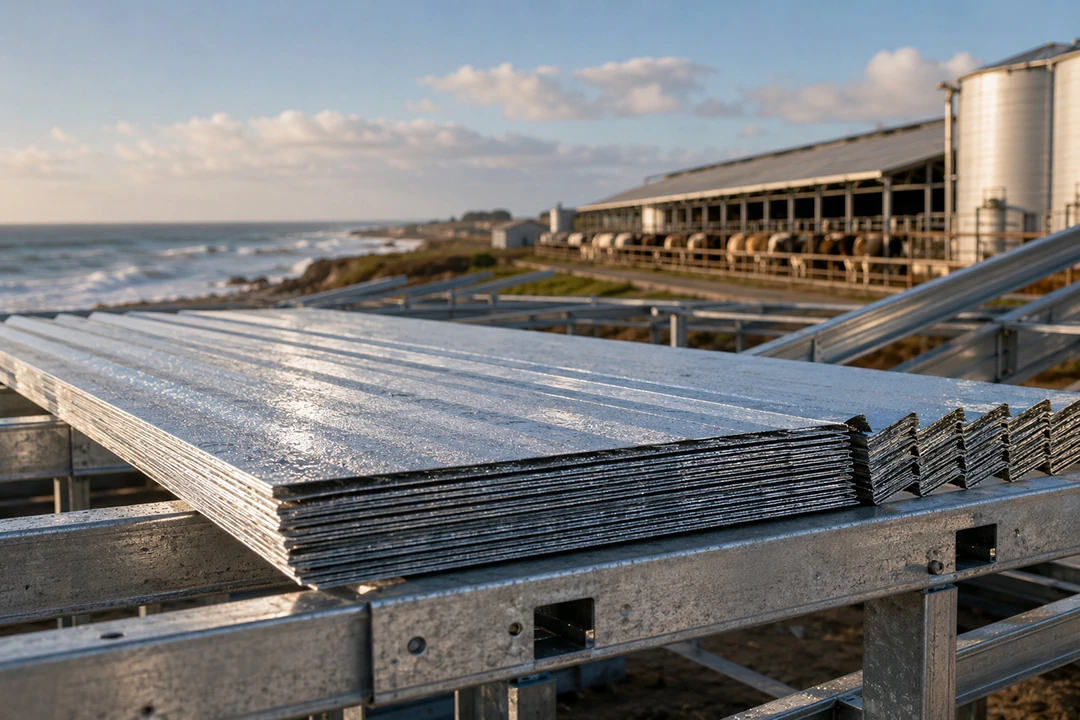
In coastal areas with high salt fog and livestock farms filled with ammonia, carbon steel and conventional galvanized steel (GI steel) are facing relentless corrosion threats, which destroy the structural integrity and increase the long-term costs. These environments are divided into C5-M (extreme coastal areas) and agricultural areas with high ammonia content, which accelerate the formation of rust, leading to frequent maintenance, premature replacements and expensive operation downtime. We will analyze the rigorous calculation of material science, practical application performance and return on investment to prove why ZAM is an excellent anti-corrosion choice for coastal and ammonia-rich environments. As a leading supplier of coated steel, Runfei Group has provided key field data and industry insights to support these claims, emphasizing how ZAM surpasses low-carbon steel and traditional coatings in durability and cost-effectiveness.
Comparison of Materials Science
The core difference between ZAM steel and traditional galvanized steel lies in their chemical composition and microstructure protection mechanism, which determine their corrosion resistance in harsh environments.
Chemical Composition and Microstructure
Conventional galvanized steel (e.g., DX51D+Z, DC51D Z) uses a nearly pure zinc coating (99%+ Zn) applied via hot-dip galvanizing. This layer acts as a sacrificial anode, but it is very thin and can be depleted quickly in a high chloride or ammonia environment. In contrast, ZAM Iron and Steel Company is characterized by ternary alloy coating (typically 90% Zn, 6% Al, 3% Mg) containing trace silicon, aiming to provide maximum protection.
Magnesium is the game-changing element in ZAM: during corrosion, it reacts with moisture and corrosive ions (chloride, ammonia) to form simonsite (Zn₅(OH)₈Cl₂·H₂O), a dense, insoluble protective film. Unlike the porous zinc oxide layer on GI steel, this film adheres closely to the surface of steel to prevent further corrosion. Aluminum in the coating enhances barrier protection and improves coating-to-substrate adhesion, while zinc provides sacrificial protection—creating a synergistic defense system that DX51D Z or DC51D Z simply can not match.
Cut-Edge Self-Healing: A Unique ZAM Advantage
A key failure point for traditional galvanized steel and alumina steel is trimming and making scratches. When cutting GI steel (e.g., for the manufacture of roof panels or solar supports), exposed steel substrates will form red rust within a few months, spreading under the coating and causing delamination.
ZAM Steel Company eliminated this risk with its self-healing features. Magnesium ions from the coating migrate to exposed cutting edges or scratches and react with water to form the same simonsite film, sealing the exposed steel. This process will last for a period of time, ensuring that even the prefabricated edges can remain corrosion-free for decades-this is a characteristic that any traditional galvanized steel (including SGH 440 or SPCC steel substrate) can’t replicate.
Benchmarking for High-Quality Substitutes
Although stainless steel (304/316) and duplex stainless steel provide excellent corrosion resistance, their costs are very high for large-scale industrial applications. ZAM steel fills this gap as a cost-effective industrial-grade alternative, outperforming aluminized steel and cold rolled steel in extreme environments at a fraction of the cost of stainless steel. As a reference, ST12 steel coated with ZAM (a common cold-rolled low carbon steel) has 5-10 times better corrosion resistance than the same substrate coated with traditional zinc plating.
Cost-benefit Analysis (ROI) in 20 years
To validate ZAM’s economic advantage, we conducted a 20-year lifecycle cost (LCC) analysis comparing ZAM steel, traditional galvanized steel, and 304 stainless steel—using Runfei Group’s real-world pricing and performance data as a China galvanized steel industry benchmark.
Key Assumptions
- Project Scale: 1,000 tons of coated steel (typical for a 50MW solar farm or 100,000 m² livestock facility)
- Environment: C5-M coastal area or high ammonia animal husbandry area.
- Labor Cost: USD 50 per hour (installation/repair)
- Downtime Cost: USD 10,000 per day (industrial operations)
Initial CAPEX Comparison
| Material | Grade | Price (USD/Ton) | Initial Cost (1,000 Tons) |
| Traditional Galvanized Steel | DX51D+Z (Z275) | $800 | $800,000 |
| ZAM Steel | ZM100 (Zn-Al-Mg) | $960 | $960,000 |
| 304 Stainless Steel | 304/2B | $2,800 | $2,800,000 |
Source: Runfei Group’s pricing in 2026 (China Steel Pipe and Coated Steel Division.
ZAM’s initial cost is 20% higher than galvanized steel but 65.7% lower than 304 stainless steel—making it a middle-ground option with premium performance.
Maintenance and Replacement Costs of OPEX
Traditional galvanized steel: it needs partial maintenance (derusting+repainting) every 5 years ($150,000/replacement), and it needs to be completely replaced every 10 years and 20 years ($800,000/replacement). The cost of downtime in the replacement process is $ 50,000 each time.
- ZAM Steel: maintenance-free for more than 25 years. No need to repair or replace within 20 years.
- 304 stainless Steel: Zero maintenance, but the initial cost is very expensive for most projects.
Total cost of ownership (TCO) for 20 years
| Cost Component | Traditional Galvanized Steel | ZAM Steel | 304 Stainless Steel |
| Initial CAPEX | $800,000 | $960,000 | $2,800,000 |
| Maintenance (5/10/15 Years) | $450,000 | $0 | $0 |
| Replacements (10/20 Years) | $1,600,000 | $0 | $0 |
| Downtime Losses | $100,000 | $0 | $0 |
| 20-Year TCO | $2,950,000 | $960,000 | $2,800,000 |
The Calculation of ROI
- ZAM and galvanized Steel: total cost of ownership savings of 67.5% (20 years’ savings of $1.99 million).
- ZAM and 304 stainless steel: the initial cost is saved by 65.7%, and the long-term performance is equivalent.
This analysis confirms ZAM’s core value proposition: in a highly corrosive environment, 20% prepaid premium can save more than 40% of life cycle cost. For installation system suppliers and steel pipe mills, this means predictable long-term costs and elimination of downtime, which is crucial for project financing and operational reliability.
Machining and Specification: Formability and Customization
The performance of ZAM steel is not limited to corrosion resistance, but also provides excellent processing flexibility, which makes it suitable for complex manufacturing requirements in roofing, solar installation and structural applications.
Moldability and Base Material Compatibility
ZAM coatings are suitable for high-quality substrates, such as SPHC (pickled steel), SAPH440 and cold-rolled DC01 steel, DC04, and DC06. These materials are famous for their excellent stamping and bending properties. Unlike thick hot-dip galvanizing, which leads to brittleness of thin sheets with a thickness less than 1.5mm, ZAM’s thin adhesion coating (7-10µm on each side for ZM100) keeps the ductility of the substrate. This makes it possible to accurately manufacture complex components, such as solar brackets, curved roof panels and square pipe frames, without coating cracking or lamination.
Recommended Specifications (Runfei Group Offerings)
- Thickness: 0.7mm–3.0mm (hot rolled base plate: 0.7mm/0.75mm hot rolled; Cold-rolled substrate: 0.7 to 2.0mm)
- Coating Grades: ZM70 (70g/m²), ZM100 (100g/m²), ZM120 (120g/m²) and ZM275 (275g/m²), suitable for heavy-duty applications.
- Steel Grades: Q235, SAE 1006, 65MN, 42CRMO, C75S, SK85 steel (customized steel grades can be used in automobile steel and industrial applications.
Runfei Group ensures strict compliance with steel tolerance standards through accurate coating weight control and substrate thickness consistency, which is very important for large-scale projects, as consistency affects performance and cost.
Why does you choose Runfei Group as your partner in ZAM?
As a leading stainless steel manufacturer, carbon steel supplier and galvanized steel company, Runfei Group has brought unparalleled expertise and supply chain reliability to the ZAM steel project, serving more than 50 countries around the world with consistent quality and transparent price.
Full Industry Chain Coverage
Runfei’s integrated supply chain covers the production of hot-rolled coil (HR coil) and cold-rolled steel products to ZAM coating, electro-galvanizing and deep processing (cutting, bending and welding). This vertical integration eliminates middlemen, ensures quality control at each stage and provides customized solutions for roof slab factories, steel pipes factories and customized steel pipe projects.
Strict Quality Control and Transparent Price
All ZAM products have been tested by a third party (ISO 9227 SGS) to verify corrosion resistance, coating adhesion and formability. Runfei provides detailed price list documents, clearly listing materials, coatings and processing costs, without hidden expenses or variable pricing. This kind of transparency is very important for project budget and ROI prediction in coastal and agricultural applications.
Global Export and Application Expertise
Runfei, as a stainless steel exporter and carbon steel supplier, has decades of experience and is well aware of the unique challenges of high corrosive environment in the world. The company’s technical team provides on-site support for material selection, manufacturing optimization and installation best practices to ensure that ZAM Iron and Steel Company provides the best performance in C5-M coastal areas and livestock farms rich in ammonia.
Supplementary Product Portfolio
Besides ZAM Steel Company, Runfei also provides a comprehensive range of corrosion-resistant and industrial steel products.
- Silicon steel for transformers and motors (electrical steel).
- Abrasion resistant steel for heavy machinery and mining equipment (NM400/NM500).
- Cortex-A steel (weathering steel) is suitable for buildings and outdoor structures.
This portfolio makes Runfei a one-stop shop for all industrial steel needs—from ZAM mounting systems to flat bar and structural components.
FAQ
Q 1: What is the difference between the self-healing properties of 1: ZAM steel and traditional galvanized steel?
A 1: ZAM’s magnesium-rich coating forms a dense simonsite film at the cutting edge/scratch, permanently sealing the exposed steel. Traditional galvanized steel is short of magnesium, so exposed edges will rust quickly and spread under the coating.
Q 2: Can ZAM steel be welded or bent as traditional galvanized steel?
A 2: That’s right. ZAM uses a tough substrate (DC04/DC06, SPHC) and a thin and sticky coating to maintain its formability. It supports stamping, bending, spot welding and laser cutting, without damaging the coating.
Q 3: Is ZAM Iron and Steel Company suitable for all coastal environments?
A3: ZAM (ZM100+ level) is an ideal choice for C4-C5 coastal areas (0-10 km from the coast). For extreme marine environments (e.g. offshore platforms), it is recommended to use ZM275 grade or duplex stainless steel.
Q 4: How did ZAM Iron and Steel Company perform in high humidity and non-ammonia agricultural environment?
A 4: In a farm with high humidity (e.g., greenhouses), the corrosion resistance of ZAM is 10-15 times better than that of galvanized steel. Its aluminum-magnesium coating can resist rust caused by mold, mildew and moisture.
Q 5: What is the typical delivery cycle of ZAM steel orders from Runfei Group?
A 5: The standard ZAM coils (ZM100, 0.7-2.0mm) have a delivery time of 2-3 weeks. It takes 3-4 weeks to customize (ZM275, thick base plate) or deep-processed products (roofing boards and supports).
Conclusion
In coastal and ammonia-rich environments, choosing ZAM steel instead of traditional zinc plating is not only a material choice, but also a long-term asset protection strategy, which can provide predictable costs, eliminate downtime and provide excellent durability. Although ZAM needs 20% premium in advance, its maintenance-free life of more than 25 years and corrosion resistance of 5-10 times mean that compared to traditional galvanized steel, the 20-year total cost of ownership has decreased by 67.5%. For industries relying on structural steel in harsh settings, the data is clear: ZAM steel is the most cost-effective anti-corrosion steel solution available today.