Introduction
Cold-rolled sheet metal plays a foundational role in high-volume manufacturing sectors, particularly automotive, home appliance, and precision metal stamping. The smooth surface finish and tight dimensional tolerances of cold-rolled strip enable the production of consistent components at speed. Within European material specifications, deep drawing grades are typically ordered according to EN 10130 or the older DIN 1623 classification. Selecting the correct designation from the range that includes commercial and drawing-quality grades requires a clear understanding of their technical boundaries.
When engineering a new stamping process, the mechanical uniformity of cold rolled steel directly impacts tool life, scrap rate, and the dimensional stability of the finished part. This makes it essential to align the material choice with the complexity of the forming operation.
1. Deciphering the Naming Standards: DC01, DC04, DC06, and ST12
The EN 10130 designation begins with “DC”, where “D” indicates a flat product intended for cold forming and “C” specifies that the material has been cold rolled. The numerical suffixes 01, 04, and 06 denote increasing levels of formability. DC01 is the baseline commercial quality; DC04 offers enhanced deep-drawing capability; and DC06, an interstitial-free variant, provides the highest stretchability. These suffixes are not arbitrary but reflect tightly controlled chemical and mechanical specifications.
The grade ST12 steel, as specified in the earlier German standard DIN 1623, frequently appears in cross-border procurement documents. Its practical performance envelope is very close to that of DC01, making it a commonly accepted equivalent for commercial-quality cold-rolled strip.
Understanding this equivalency helps purchasing teams avoid redundant dual certification requests when sourcing DC01 from mills that also supply under the ST12 designation. The DC01 grade typically exhibits moderate strength and sufficient ductility for simple bending and shallow forming operations.
For components with simple geometries, DC01 steel is a reliable and cost-effective choice; compared with deep-drawing grade steels that undergo extensive processing, it strikes a good balance between formability and a lower price.
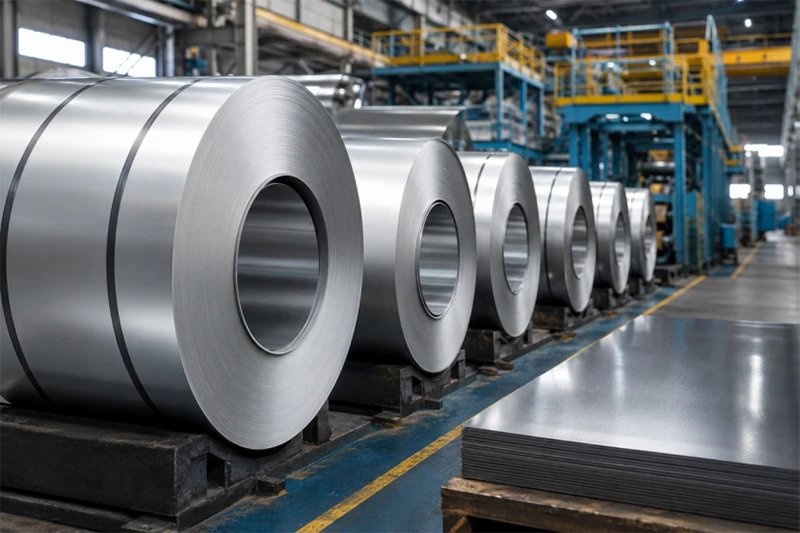
2. Comparison of Technical Parameters: Chemical Composition and Mechanical Properties
The table below lists the maximum permissible contents of carbon, manganese, phosphorus and sulphur, as well as the minimum elongation after fracture (A80) and, where applicable, the plastic strain ratio (r) and the strain hardening index (n). These parameters define how the strip will behave as it flows through a draw die. These parameters define how the strip will behave as it flows through a draw die.
| Grade | C max. (%) | Mn max. (%) | P max. (%) | S max. (%) | Yield Strength Re max. (MPa) | Tensile Strength Rm (MPa) | Elongation A80 min. (%) | r-value min. | n-value min. |
| DC01 (EN 10130) | 0.12 | 0.60 | 0.045 | 0.045 | 140 – 280 | 270 – 410 | 28 | — | — |
| ST12 (DIN 1623) | 0.10 | 0.45 | 0.035 | 0.035 | 280 max. | 270 – 410 | 28 | — | — |
| DC04 (EN 10130) | 0.08 | 0.40 | 0.030 | 0.030 | 210 max. | 270 – 350 | 34 | 1.4 | 0.18 |
| DC06 (EN 10130) | 0.02 | 0.25 | 0.020 | 0.020 | 180 max. | 270 – 350 | 37 | 1.8 | 0.22 |
Unless otherwise stated (e.g. where a range or minimum value is specified), the figures listed are upper limits. These data reveal a clear trend: as formability requirements increase, steelmakers reduce the carbon content and impose stricter limits on residual elements to enhance the material’s ductility.
DC04 steel is a typical example of this shift towards higher formability, with a maximum carbon content of 0.08 per cent and a guaranteed post-fracture elongation of no less than 34 per cent. This low-carbon composition enables the material to withstand a high degree of deep drawing without developing surface roughness or microcracks—problems that often arise when stamping processes push standard commercial-grade steels beyond their ductility limits.
For applications with even more demanding formability requirements, DC06 steel is produced as an interstitial-free (IF) steel, with its carbon content controlled to below 0.02 per cent. This confers an extremely high plastic strain ratio (r-value) on the steel grade, enabling it to effectively resist thinning during multi-pass deep drawing. For automotive exterior panels and ultra-deep-drawn cylindrical parts, the metallurgical properties of DC06 steel provide the necessary safety margin to effectively prevent cracking.
3. Application Suitability: Choosing the Right Grade for Your Stamping Projects
Choosing the right cold-rolled substrate for a stamping project involves balancing material cost, die wear, scrap rate, and the geometric severity of the part. Over-specifying a high-formability grade raises per-unit cost unnecessarily, while an under-specified sheet can generate chronic splitting issues on the press line.
For simple enclosures, flat brackets, and shallow channels, DC01 steel delivers a pragmatic solution. Its lower cost per ton and adequate elongation make it the default choice for parts that require only bending or minimal stretch forming, such as electrical cabinets and general-purpose brackets.
When the part design incorporates deeper draws—as seen in washing machine drums, automotive inner structural members, or certain drawn cookware—the DC04 grade comes into its own. Its controlled chemistry supports more aggressive material flow while retaining a smooth surface finish, helping manufacturers maintain consistent quality across high-volume production runs.
For these intermediate-deep-drawing applications, DC04 steel represents a well-established benchmark. Its balance of formability and cost has made it a staple in European press shops for decades.
At the extreme end of the formability spectrum, DC06 is specified for complex automotive outer skins, deep-drawn cylinders with tight bottom radii, and precision sanitary components. For international procurement teams, approximate cross-references can assist initial material screening: DC01/ST12 broadly parallels JIS SPCC and ASTM A1008 CS, DC04 aligns with SPCD and ASTM A1008 DS, and DC06 corresponds to SPCE and ASTM A1008 DDS. These equivalencies, while not exact in their chemical ceilings, offer a practical starting point for transitioning between regional standards.
4. Sourcing Reliable Cold Rolled Substrates: Why Material Consistency Matters
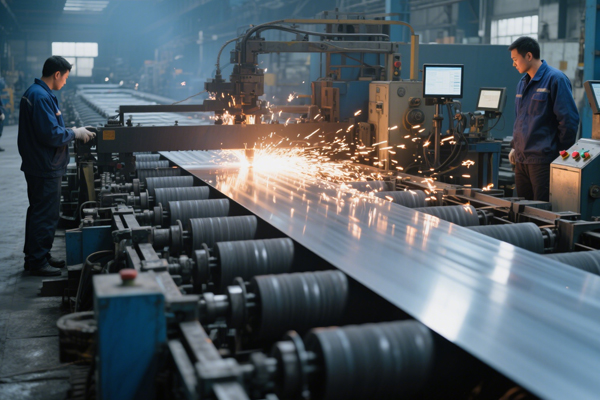
Regardless of the grade selected, the real-world performance of a cold-rolled coil depends heavily on the consistency of its mechanical properties and gauge tolerance. In automated high-speed transfer presses, fluctuations in yield strength or thickness introduce variables that disrupt the forming process, leading to increased die adjustment time, higher scrap rates, and premature tool wear. A strip that varies in thickness across its width can cause uneven blank holding forces and localized wrinkling, while a batch that trends to the upper end of the strength range may exhibit excessive springback, taking parts out of geometric specification.
Runfei Group supplies a comprehensive range of cold rolled steel coils and sheets that cater to both general commercial and deep drawing requirements. Their portfolio includes grades from the DC01/ST12 commercial level up to DC04-class formability, all produced with careful attention to gauge uniformity and surface quality.
In addition to mill-grade material supply, Runfei Group supports downstream manufacturing through precision slitting and cut-to-length processing. By delivering slit coils and blanks held to tight width tolerances, the company helps stamping operations minimize material handling waste and simplify their incoming inspection workflows. Consistent certification data accompanies each shipment, allowing process engineers to calibrate their press parameters with confidence.
As a cold rolled steel manufacturer focused on supply chain reliability, Runfei Group works to ensure that the mechanical characteristics of each coil remain repeatable from order to order. This repeatability is essential for maintaining the rhythm of automated press lines and protecting the investment in high-precision tooling.
Conclusion
In summary, the European cold-rolled deep drawing grades form a graduated system: DC01 and ST12 for basic bending, DC04 for true deep drawing, and DC06 for the most challenging stretch-drawing operations. The key to cost-effective stamping lies in matching the material specification to the forming severity rather than defaulting to the highest grade. Doing so requires close collaboration between design engineers, tooling specialists, and material suppliers to validate the process window.
Should you have any technical enquiries regarding grade equivalence, or wish to request the latest steel mill specifications and quotations, please do not hesitate to contact Runfei Group. We have an experienced cold rolled steel manufacturer, ready to meet your production requirements at any time.