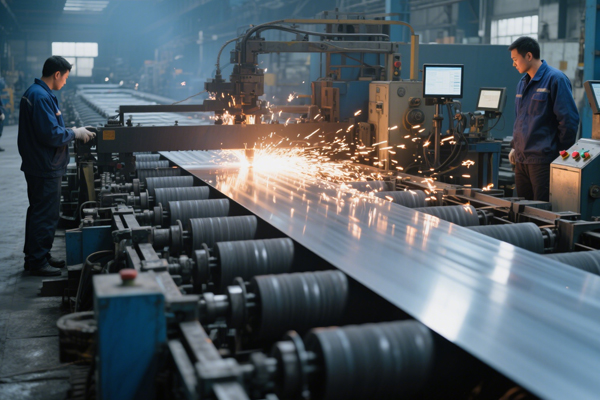
1. Introduction: The Extreme Wear Challenge in Mining Operations
In hard-rock mining, excavator buckets and transfer chutes face a relentless combination of heavy impact, high-stress sliding abrasion, and gouging from sharp, fractured ore. Unscheduled downtime caused by wear-related failures can rapidly drain operational profitability. Choosing a wear material is more than a purchasing decision. It directly affects maintenance frequency, equipment availability, and the overall cost of operating the machine. For decades, the choice has largely revolved around two distinct families of abrasion resistant steel: traditional high manganese (Hadfield) steel and modern quenched and tempered grades such as the 450 HBW specification. For most maintenance teams, the key question is simple: which material delivers the longest, most reliable service life under a specific wear regime? The following comparison explains where each material performs well—and where it doesn’t—so engineers can choose the right option for their working conditions.
2. What is High Manganese Steel (Hadfield Steel)?
2.1 Mechanical Mechanism: Work-Hardening Under Impact
High manganese steel, standardized as ASTM A128, typically contains 11–14% manganese and 1.0–1.4% carbon. In its as-supplied condition, it possesses a fully austenitic microstructure and a relatively low initial hardness of approximately 200 HBW (ASM Handbook, Vol. 1). Its wear resistance develops only after the material has been exposed to repeated impact. When the surface is subjected to repeated heavy impact or high-pressure compression, the austenite undergoes strain-induced transformation into extremely hard martensite. In applications with continuous heavy impact, the surface can harden to more than 500 HBW while the inner material retains its toughness. That’s why high manganese steel is commonly used for bucket teeth, crusher liners, and other parts exposed to repeated rock impact.
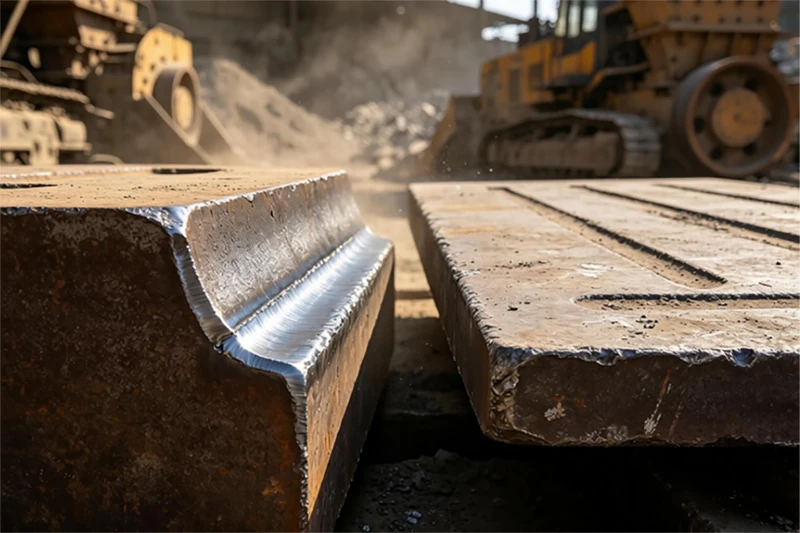
2.2 Limitations in Sliding Wear Conditions
The downside is that this benefit depends entirely on impact. In applications characterized by low or moderate impact — such as fine ore sliding down a chute liner or abrasive sand moving against a bucket side wall — the impact energy is frequently insufficient to trigger the martensitic transformation in a reliable way. In these sliding wear scenarios, high manganese steel can wear at an accelerated rate because it never develops the protective hard surface it is famous for. Without enough impact, the material stays relatively soft and wears much faster than expected.
3. What is NM450 Wear-Resistant Steel?
3.1 Understanding the Performance of This Grade
The through-hardened plate designated as NM450 belongs to the Chinese GB/T 24186 standard family. The “NM” prefix stands for “Nai Mo” (wear resistant), and the number indicates its nominal Brinell hardness of 450 HBW, with a typical production range of 420–480 HBW (GB/T 24186; ASM Handbook, Vol. 1). It is manufactured by a controlled quenching and tempering process that develops a fine-grained martensitic-bainitic microstructure across the full plate thickness. Because the plate is already hardened during production, it reaches the job site ready for use without relying on work hardening during service. The material arrives with guaranteed mechanical properties, including predictable tensile strength and notched-bar impact toughness at low temperatures.
3.2 Key Advantages over Standard Structural Plate
Compared with conventional structural steel, a quenched and tempered wear plate offers dramatically increased resistance to sliding wear. Its pre-hardened condition means that from the very first tonne of material that passes over the surface, the wear face is already at its full working hardness. Wear performance is consistent from the beginning instead of improving gradually during operation. The balanced chemical composition — typically including controlled additions of chromium, molybdenum, and boron — provides deep hardenability and a favourable strength-toughness ratio, which helps to reduce the risk of cracking during fabrication when the correct workshop procedures are followed.
3.3 Extending Performance with Higher Hardness Grades
For liners and buckets exposed to extremely abrasive yet moderate-impact environments where a 450 HBW plate may still show gradual thickness loss over extended campaigns, an upgrade to NM500 steel is often evaluated. This grade delivers a nominal hardness of 500 HBW, typically falling within a 470–530 HBW window, and offers a measurable step up in resistance to low-stress scratching abrasion. It is important to recognise that the increase in hardness comes with a slight reduction in formability and a more stringent requirement for preheating during welding. The choice between a 450 HBW material and this harder specification therefore represents a deliberate trade-off between maximum wear life and practical field fabricability.
4. Technical Comparison Table: High Manganese vs. NM450
The table below summarises key properties to allow a direct, structured comparison. The values represent typical data for commercially available grades; specific mill certificates should always be consulted before final engineering decisions.
| Property | High Manganese Steel (Hadfield) | NM450 Wear-Resistant Grade |
| Initial Hardness (HBW) | ~200 HBW (ASM Handbook, Vol. 1) | 420–480 HBW (GB/T 24186) |
| Work-Hardening Capacity | Excellent under high impact; surface can reach ≥500 HBW | Negligible; hardness is built in through quenching and tempering |
| Key Wear Mechanism Suitability | High-impact gouging, heavy compression | Sliding abrasion, low-to-moderate impact erosion |
| Weldability | Good with specific consumables; prone to embrittlement if overheated | Fair to good; low-hydrogen practice with preheat recommended; generally more forgiving for field repairs |
| Machinability & Cutting | Challenging; work hardening during cutting demands rigid setups | Readily cut by plasma, laser, or water jet with standard parameters |
| Primary Failure Mode | Accelerated wear under insufficient impact; surface cracking under extreme repeated overload | Gradual thickness loss through steady abrasion; possible brittle fracture if used in extreme, unsupported impact |
| Typical Density (g/cm³) | ~7.9 | ~7.85 |
5. Application Guidelines: Buckets vs. Chutes
5.1 Material Selection for Excavator Buckets
An excavator bucket is not a single wear environment. The lip shroud, adapters, and teeth engage the rock face through high-energy penetration and prying; these components often benefit from high manganese steel castings because the massive impact forces continuously regenerate the hard surface layer. However, the internal liner plates and the bucket shell mainly guide the excavated material and experience a greater proportion of sliding friction. In these areas, installing liner plates made from a modern quenched and tempered abrasion resistant steel can significantly reduce abrasion loss while allowing a lighter bucket structure. A well-engineered bucket strategy frequently combines the two approaches: manganese castings at the direct impact zones and pre-hardened wear plates in the material flow path.
5.2 Material Selection for Mining Chutes
Transfer chutes in a mineral processing plant seldom experience the kind of catastrophic single-impact loads seen at the digging face. Instead, millions of tonnes of crushed rock travel down the chute, generating continuous sliding abrasion and, at best, moderate repeated impacts. Because of this, high manganese steel often fails to reach meaningful work hardening and can wear through relatively quickly, particularly when handling fine, non-simulating material. Consequently, a through-hardened plate with a nominal hardness of 450 HBW is widely recognised as the more cost-effective and technically sound choice for chute liners, deflector plates, and hopper plating. Where wear intensity is exceptionally high, some operations progress to a 500 HBW grade to further extend relining intervals, provided the supporting structure can accommodate the slightly more restrictive processing needs of the harder plate.
6. Sourcing Wear Solutions from Runfei Steel Group
Translating this material selection knowledge into reliable, project-ready components requires a supplier with both technical depth and processing capability. Runfei Steel Group, a specialist steel producer that has served the global heavy equipment sector since 1998, supplies a comprehensive range of wear-resistant plate grades including 450 HBW, 400 HBW, and 500 HBW specifications. The company understands that mine sites need more than raw plate — they require parts that can go straight into service. Runfei offers downstream processing according to customer engineering drawings, including precision cutting, bevelling, bending, and drilling of wear plates, helping to reduce on-site preparation time. For procurement managers and engineers evaluating a transition from conventional materials to high-performance wear plate, involving a knowledgeable supplier early in the design stage can streamline grade qualification and ensure that the as-delivered fabrication properties match the intended operational duty cycle.
7. Conclusion
Neither material is the right choice for every application. The choice between high manganese steel and a pre-hardened NM450 specification ultimately hinges on one operational variable: the ratio of impact to abrasion. Where massive, high-energy rock impact dominates and can reliably trigger work hardening, high manganese steel remains a proven performer. In the far more common sliding wear and moderate-impact regimes found in chutes, hoppers, and the internal liners of excavator buckets, the immediate and consistent hardness of a 450 HBW or 500 HBW grade typically delivers lower life-cycle costs per tonne of material moved. A data-driven approach — measuring the prevailing wear mechanisms and consulting with a technically qualified steel provider — is what ultimately protects both equipment uptime and the maintenance budget.
Frequently Asked Questions
Q: What is the core difference between high manganese steel and a pre-hardened 450 HBW grade?
A: High manganese steel depends on intense in-service impact to transform its surface from an initial soft condition into a hard, wear-resistant layer. A quenched and tempered plate with a nominal hardness of 450 HBW, by contrast, arrives with its full working hardness already developed; it does not need impact to deliver wear performance and is much better suited to sliding abrasion.
Q: Can a 450 HBW wear plate be used for excavator bucket teeth?
A: Bucket teeth and adapters are typically exposed to extreme, concentrated impact, which is the ideal operating condition for high manganese steel. A pre-hardened 450 HBW plate is not a direct substitute for manganese castings at the digging tip. It is, however, an excellent choice for the internal wear liners and structural parts of the bucket shell.
Q: When should I consider stepping up from a 450 HBW grade to a 500 HBW grade?
A: An upgrade is worth evaluating when you observe that 450 HBW liners are wearing out primarily through pure sliding abrasion, without any impact-related cracking appearing first. The 500 HBW grade offers higher surface hardness and can extend service life in highly abrasive, low-impact flow zones, provided that the fabrication workshop is equipped to handle its slightly reduced weldability.
Q: How can I be sure I am purchasing specification-compliant wear plate?
A: Always request a mill test certificate that reports the actual Brinell hardness values and full chemical composition for the specific heat. Reputable suppliers, such as those operating as a certified alloy steel manufacturer, can provide full traceability to GB/T 24186 or an equivalent internationally recognised standard.