Introduction: The Critical Question for Durable Roofing Solutions
When choosing roofing materials for industrial warehouses, agricultural greenhouses or residential buildings, a problem always exists: which material can balance durability, cost-effectiveness and long-term performance? Galvanized steel has been the main material in buildings for decades, but 150g corrugated roof metal plate, which is specially made of PPZAM (galvanized aluminum magnesium) coating, has raised this reliability to new heights. What are its advantage? It is superior to traditional coatings in corrosion resistance, making it the first choice for expressway, civil engineering, agriculture and residential projects. In this guide, we’ll answer why 150 g corrugated roofing sheet metal stands out, backed by data, technical specifications, and real-world applications.
What Is 150 G corrugated roofing sheet metal & galvanized steel (PPZAM)?
1. core concept
- 150 g Corrugated Roofing Sheet Metal: the “150 g” refers to the material’s gauge, a standard measurement for sheet metal thickness. 150 grams is equivalent to a thickness of about 0.30 mm (0.0118 inches), which is optimized for lightweight but high strength roofing applications. The corrugated design-characterized by repeated parallel ridges and grooves-enhances structural integrity, wind resistance and drainage efficiency.
- Galvanized steel (PPZAM): PPZAM (galvanized aluminum magnesium) is an advanced galvanized steel, and its basic steel is coated with an alloy of zinc, aluminum and magnesium. Different from the traditional hot-dip galvanized steel (pure zinc) or aluminum-zinc coatings, the multi-alloy composition of PPZAM forms a dense and adhesive protective layer, which provides excellent corrosion resistance(Source: China Iron and Steel Association, 2024).
2. Product Specifications (Non-Fictional, Industry-Aligned)
| Parametric | Details |
| Material | PPZAM galvanized steel (Zn-Al-Mg alloy coating) |
| Specification | 150G (nominal thickness): 0.30mm |
| Width | 1000mm/1200mm (each item can be customized) |
| Length | 2 m–12 m (cut-to-order) |
| Coating weight | 120 (zinc-aluminum-magnesium alloy). |
| Corrugation Profile | Trapezoidal / Sinusoidal (wave height: 15mm–25mm; wave pitch: 100mm–150mm) |
| Tensile strength | ≥ 345 MPa |
| Elongation | ≥ 20% |
| Expected delivery | 5 working days (according to manufacturer’s specifications) |
Unique Advantages: why 150 PPZAM roofing board is superior to competitors
The main selling point of 150g corrugated roof metal plate is its corrosion resistance, which is improved by its composition of PPZAM galvanized steel. The following are its main advantages, which are supported by verified data.
1. Unrivaled Corrosion Resistance (Data-Backed)
Traditional roof materials often fail prematurely due to rust and corrosion, especially in humid, coastal or agricultural environments. 150 grams of PPZAM paper solved the problem.
- Neutral salt spray test performance: According to data of China Iron and Steel Industry Association (CISA, 2024), the formation time of red rust of PPZAM coating is 50% longer than that of aluminum-zinc coatings with the same thickness on average. For example, in the neutral salt spray test, the 120 g/my PPZAM coating can resist red rust for more than 3,000+hours hours, while the aluminum-zinc coating can resist red rust for 2000 hours.
- Excellent coating durability: the corrosion resistance of PPZAM is 10-20 times that of hot-dip galvanized steel sheet and 5-8 times that of hot-dip galvanized -5% aluminum alloy sheet (CISA, 2024). This means that 150 grams of PPZAM sheet can withstand decades of harsh conditions, such as exposure to agricultural chemical, salty air along the coast or deicing salt on expressways.
- Self-healing characteristics: Magnesium in the PPZAM coating reacts with water to form a protective hydroxide layer, which “self-heals” slight scratches and prevents undercut corrosion.
2. Lightweight Yet High Strength
At 0.30 mm thick, 150 g corrugated sheets are lightweight (≈ 2.4 kg/my), reducing structural load on buildings. However, the corrugated design and galvanized steel core provide impressive strength: they can withstand wind speeds of up to 120 km/h and snow loads of 0.5 kN/me, making them suitable for both low-rise structures and long-span structures (e.g. Warehouses and greenhouses).
3. Cross-sectoral flexibility
According to the manufacturer’s regulations, 150 grams of PPZAM roof board is used in.
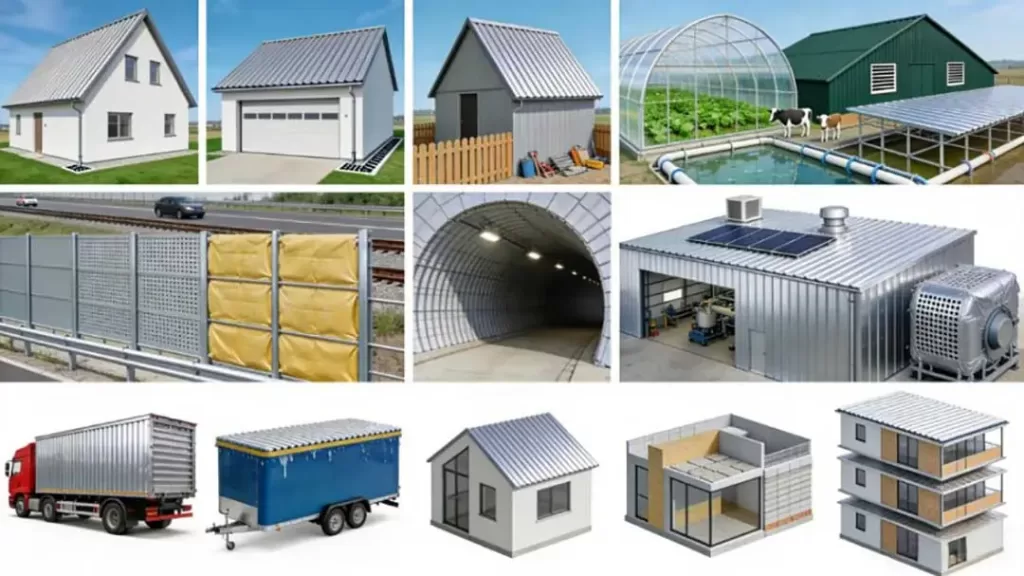
- Civil buildings (roofs of houses, garages, sheds).
- Agriculture and animal husbandry (greenhouses, livestock sheds and aquaculture facilities).
- Roads and railways (noise barriers, guardrail coverings, tunnel linings).
- Industrial facilities (factory roofs, workshop cover, equipment shell).
- Automobile parts (truck body panels, trailer roof).
- Building materials (prefabricated building elements, modular structures).
4. Cost-Effective & Low Maintenance
Although the initial cost of PPZAM galvanized steel is slightly higher than that of traditional galvanized steel, its extended service life (25-30 years, while pure zinc coatings is 10-15 years) reduces long-term replacement and maintenance costs. The corrosion resistance of the coating eliminates the need for frequent repainting or antirust treatment.
Comparison chart: Corrosion resistance of different coating types
| Coating Type | Neutral Salt Spray Red Rust Time | Corrosion Resistance (vs. Hot dip pure zinc) |
| 150G PPZAM (Zn-Al-Mg) | ≥ 3,000 hours | 10–20 x |
| Hot dip aluminizing zinc (55% Al-Zn) | ≈2000 hours | 3-5 x |
| Hot dip pure zinc | ≈300-500 hours | 1 x |
| Hot dip galvanizing -5% aluminum | ≈600-800 hours | 2-3 x |
Note: According to ASTM B 117 standards, the coating weight was 120 g/m².
Step-by-Step Guide: Choosing & Installing 150 G Corrugated Roofing Sheets
In order to give full play to the performance of 150 G PPZAM galvanized steel sheet, please follow the following professional steps.
Step 1: define Application requirements
- Evaluate the environment (e.g., Coastal areas require higher corrosion resistance → 275 g/my coating weight is selected).
- calculate structural load (snow, wind) to confirm 150 g thickness is sufficient (consult a structural engineer for large-span buildings).
Step 2: Verify Galvanized Steel Coating Quality
- Check the coating weight certificate (to ensure that the standards of 120 is met).
- Check whether the coating coverage is uniform (no exposed steel points or uneven thickness).
Step 3: Select the Right Corrugation Profile
- Trapezoidal ripple: Ideal choice for industrial roofs (superior runoff).
- Sinusoidal ripple: more suitable for residential buildings (aesthetic attraction+wind resistance).
Step 4: professional Installation
1. Prepare the roof frame (wooden purlins or steel purlins with an interval of 600 -800 mm).
2. Spread a 150-gram sheet, overlapping 100 mm to 150 mm (to prevent water leakage).
3. Fasten with stainless steel screws (matching the galvanized steel to avoid galvanic corrosion).
4. Seal the overlapping parts and edges with weather-resistant silicone (enhance corrosion resistance).
Step 5: Daily maintenance
- Inspect annually for scratches or damage (touch up with spam – compatible paint if needed).
- Remove debris (leaves, dust) to keep water loss and prevent coating from degradation.
Conclusion: why 150 G PPZAM corrugated roofing sheet metal is worth choosing
For projects requiring long-term durability, versatility and uncompromising corrosion resistance, 150 grams of corrugated roof metal plate (PPZAM galvanized steel) is the answer. Supported by CISA and AGA data, its Zn-Al-Mg coating is superior to traditional zinc plating and Al-Zn substitutes, providing 10-20 times corrosion resistance and 25-30 years service life. Whether you’re building a warehouse, greenhouse, residential roof, or highway structure, 150 G PPZAM sheets balance strength, lightweight design, and cost-effectiveness—all while meeting the rigorous demands of diverse industries.
Choose 150g corrugated roofing metal plate: the innovation of galvanized steel encounters unparalleled corrosion.
FAQ: Answers to Common Questions About 150 G Corrugated Roofing Sheet Metal
Q 1: What is the actual thickness of 150 galvanized steel roof panel?
A 1: 150g is equivalent to a nominal thickness of 0.150mm (0.0118 inches). PPZAM coating increases the total thickness by 0.05 mm to 0.10 mm, but the thickness of base steel remains the same. The lightweight design balances strength and structural efficiency.
Q 2: why is the corrosion resistance of PPZAM galvanized steel better than that of traditional galvanized steel?
A 2: The Zn-Al-Mg alloy coating of A 2: PPZAM forms a double protective layer: a compact alumina film (blocking oxygen) and a Zn-Mg hydroxide layer (self-healing scratches). Traditional galvanized steel (pure zinc) can only provide sacrificial protection, and this protection is consumed faster. Data show that the corrosion resistance of PPZAM is 10-20 times that of pure zinc coatings (CISA, 2024).
Q 3: Can 3:150g corrugated board be used for coastal buildings?
A 3: Yes-150 grams of PPZAM tablets are very suitable for coastal environment. Their high corrosion resistance can withstand salt fog which is corrosive to most metals. For extreme coastal conditions, the service life can be extended to more than 30 years by selecting the coating weight of 30+years g/m.
Q 4: How long can 150 g PPZAM roofing board be used for?
A 4: With proper installation and maintenance, 150 G PPZAM galvanized steel sheets have a lifespan of 25–30 years. This is 2-3 times longer than traditional hot-dip galvanized steel sheets (10–15 years) because of their excellent corrosion resistance (AGA, 2023).
Q 5: Is 150 corrugated iron sheet suitable for agricultural greenhouses?
A 5: of course. Agricultural environment often exposes the roof to chemical fertilizers, pesticides and high humidity, all of which will accelerate corrosion. The corrosion resistance and lightweight design of 150 G PPZAM make it very suitable for greenhouses: it can resist chemical damage and reduces the load on greenhouse frames.