Introduction
For overseas buyers sourcing materials for coastal or high-salinity projects, the single greatest concern is premature corrosion. Steel that begins to rust within months of installation—rather than lasting the expected 15, 20, or even 30 years—translates directly into crippling maintenance costs, unplanned replacements, and reputational damage.
The solution to corrosion, however, is not simply purchasing the “most expensive steel.” It requires a scientific matching of material properties to environmental severity—based on corrosivity categories (C3 through C5), salt spray test data, and project budget.
As a galvanized steel manufacturer with extensive export experience, Runfei Group applies materials science and laboratory test data to help buyers objectively compare the corrosion resistance of different coated steel products. Located in Tianjin’s Hangu Industrial Park with a 170-acre manufacturing base, 30,000-ton indoor storage capacity, and 300,000-ton annual processing capacity, Runfei has been serving international markets since 2006. This guide draws on established industry standards and test methodologies to provide a practical framework for material selection in corrosive environments.
Core Material Analysis: Corrosion Protection Mechanisms of GI, GL, and PPGI
Understanding how different coated steels resist corrosion at the microscopic level is essential for making informed procurement decisions.
GI Steel (Galvanized Steel): Sacrificial Anode Protection
GI steel—galvanized iron—is coated with a layer of pure zinc (typically 99% or higher). Zinc is more electrochemically active than iron. In humid air, zinc oxidizes preferentially, forming a dense protective layer of basic zinc carbonate. More importantly, at cut edges or scratches where the steel substrate is exposed, zinc continues to provide sacrificial cathodic protection—corroding itself to protect the underlying steel. This makes GI steel particularly valuable for applications involving extensive cutting, punching, or bending.
GL Steel (Galvalume Steel): Dual Barrier and Sacrificial Protection
GL steel—galvalume—features a coating composed of 55% aluminum, 43.4% zinc, and 1.6% silicon. The aluminum component forms a dense, stable aluminum oxide barrier that physically blocks moisture and oxygen from reaching the steel substrate. The zinc component provides cathodic protection. This dual mechanism delivers superior flat-surface corrosion resistance compared to traditional GI steel in many environments. GL steel also offers excellent heat reflectivity, making it a preferred choice for roofing applications in tropical climates.
Prepainted Galvanized Steel (PPGI): Composite Protection
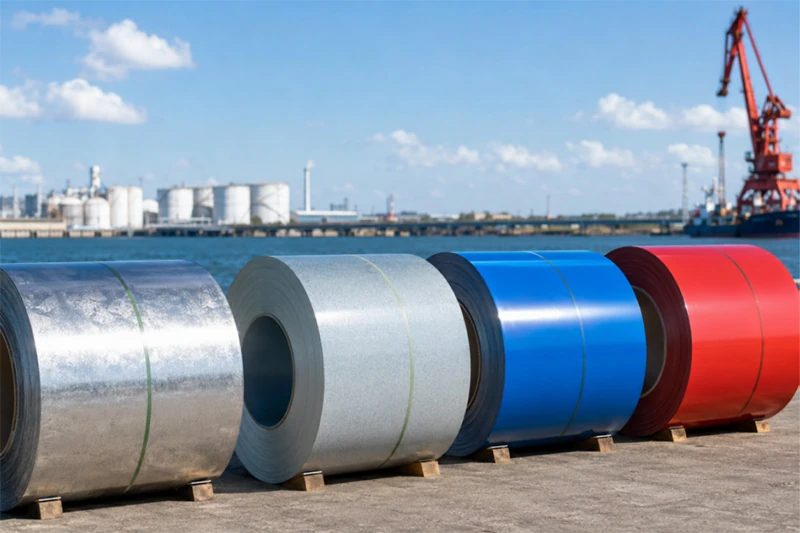
Prepainted galvanized steel—PPGI—combines a GI steel substrate with a multi-layer organic coating system (primer plus topcoat). The organic paint layer—available in formulations such as PE (polyester), HDP (high-durability polyester), or PVDF (polyvinylidene fluoride)—serves as the first line of defense, creating a robust physical barrier against corrosive media. The underlying zinc layer provides a second chemical line of defense should the paint layer be compromised. This dual-layer protection makes PPGI particularly well-suited for applications requiring both corrosion resistance and aesthetic longevity.
Salt Spray Showdown: GI vs. GL vs. PPGI—Test Data Comparison
Salt spray testing, conducted according to ASTM B117, is the industry’s most widely recognized accelerated corrosion test method. The following table presents comparative performance data based on industry-standard testing.
| Evaluation Metric | GI Steel (Galvanized) | GL Steel (Galvalume) | Prepainted Galvanized Steel (PPGI) |
| Metallic Coating Composition | 99%+ pure zinc (Zn) | 55% Al – 43.4% Zn – 1.6% Si | Pure zinc substrate + organic primer/topcoat (PE/HDP/PVDF) |
| Standard Salt Spray Test (ASTM B117) — Red Rust Appearance | Approx. 500–1,500 hours (coating-weight dependent; Z275 typically exceeds 1,500 hours) | Approx. 1,500–3,000 hours (coating-weight dependent; AZ150 exhibits 1,500+ hours) | Approx. 1,000–2,500+ hours (coating-system and topcoat thickness dependent; PVDF systems often exceed 1,500 hours) |
| Cut-Edge and Scratch Protection | Excellent. Zinc’s high electrochemical activity effectively protects exposed steel at cut edges through sacrificial action. | Moderate. The aluminum barrier reduces zinc’s sacrificial effectiveness at cut edges, making “edge red rust” a greater concern. | Moderate to excellent. Depends on substrate zinc coating weight and whether edge-protection paint is applied. |
| Acid/Alkali Resistance (Coastal-Industrial) | Poor. Pure zinc consumes rapidly in acidic (acid rain) or highly alkaline environments. | Good acid resistance (due to aluminum protection), but performs poorly in strong alkaline or cement-ammonia environments. | Excellent. PVDF/HDP organic coatings offer strong chemical corrosion resistance and UV stability. |
| Coastal Environment Design Life | Short to medium-term (zinc-weight dependent). Not recommended for bare use within 1–2 km of coastlines. | Medium to long-term (dry coastal). In heavy salt spray or high-shear applications, edge rust protection requires special attention. | Long-term. PVDF or specialized high-durability coatings maintain both aesthetics and corrosion protection over extended periods. |
Coastal Procurement Guide: Material Selection by Application Scenario
The ISO 12944 standard classifies atmospheric corrosivity into categories from C1 (very low) through CX (extreme offshore). For coastal applications, the relevant categories are C4 (high—industrial areas and coastal areas with moderate salinity), C5 (very high—coastal areas with high salinity), and CX (extreme—offshore).
By Distance from Coastline
Heavy Salt Spray Zone (within 1 km — C5 / CX Corrosivity):
Bare GL steel is not recommended. The recommended solution is prepainted galvanized steel with high-performance PVDF coating, or GI steel with heavy zinc coating (Z275 or above) supplemented with UV-resistant paint. Z275-grade GI coils typically withstand 1,000+ hours in salt spray tests and can deliver 20–30 years of service life in harsh environments with minimal maintenance.
Moderate Coastal Zone (1–5 km — C4 Corrosivity):
High-specification GL steel (AZ150 or above) offers excellent cost-performance value. Its superior heat reflectivity (up to 75%) makes it particularly suitable for tropical coastal buildings. AZ150-coated products can achieve 2–4 times the lifespan of traditional galvanized steel in these environments.
Consider Physical Damage from Fabrication:
If the project involves extensive on-site shearing, punching, or bending—common in complex anti-corrosion steel structural components—cut-edge protection becomes critical. In such cases, heavy-zinc GI steel or next-generation materials like zinc-aluminum-magnesium (ZAM) steel offer more reliable protection than GL steel, due to GI’s superior sacrificial protection at exposed edges.
Next-Generation Coastal Corrosion Solution: Zinc-Aluminum-Magnesium (ZAM) Steel
As an emerging industry leader, ZAM (zinc-aluminum-magnesium) coated steel represents the forefront of corrosion protection technology. ZAM is a hot-dip coated steel where the coating contains zinc, aluminum, and magnesium—typically in proportions such as Zn–11% Al–3% Mg.
Core Advantage: ZAM exhibits a “self-healing” capability in salt spray environments. At cut edges or scratches, magnesium, aluminum, and zinc ions migrate with moisture and form a dense protective film (simonkolleite) that seals the exposed steel surface. This fundamentally addresses the “edge rust” problem that plagues coastal projects. ZAM offers 5 to 10 times the corrosion resistance of traditional galvanized steel in salt spray tests, and can deliver service lives exceeding 25 years with minimal maintenance.
Runfei Group‘s Customized Coastal Corrosion Solutions
As a trusted partner for international buyers, Runfei Group provides comprehensive support for coastal project material selection:
Material Specification Customization: Runfei supplies coated steel products conforming to international standards including ASTM A653, JIS G3302, and EN 10346.
- GI Steel Coils/Sheets: Available from DX51D+Z commercial grade to high-strength S350GD+Z structural grade. Zinc coating weights can be customized from Z40 to Z275 based on project requirements. S350GD offers minimum yield strength of 350 MPa, making it ideal for load-bearing applications in renewable energy and infrastructure projects.
- GL Steel Coils: Available in AZ100 to AZ150 coating weights, combining high heat reflectivity with long-term corrosion resistance.
- PPGI/PPGL Coated Steel: Available with PE, HDP (high-durability polyester), and PVDF coating systems, complemented by a full range of RAL color options.
Rigorous Testing and Quality Control: Every batch of corrosion-resistant steel exported by Runfei can be supported by third-party inspection reports (SGS, BV, TUV) and salt spray test data comparisons. This ensures that the actual corrosion protection performance of delivered materials aligns with project design requirements. Quality inspection for GI steel focuses on coating weight, uniformity, adhesion, and appearance, while PPGI inspection adds rigorous checks on paint film thickness, adhesion, and long-term performance.
Frequently Asked Questions (FAQ)
Q: Can traditional hot-dip galvanized steel (GI) be used directly in coastal projects?
A: Yes, but it depends on zinc coating weight and distance from the coastline. Conventional low-zinc coatings (e.g., Z100) are rapidly consumed in high-salt environments. For near-shore applications, Z275 or above is recommended, or alternatively, prepainted galvanized steel with an additional organic coating layer.
Q: Why does GL steel generally offer better corrosion resistance than GI steel, yet performs poorly in highly alkaline environments?
A: Aluminum forms a strong protective oxide film in acidic environments, but in strong alkaline conditions (such as high-concentration ammonia or cement slurry), aluminum undergoes amphoteric dissolution—it reacts chemically with the alkali. In such environments, the sacrificial zinc layer of GI steel actually performs more reliably.
Q: What is the difference between PVDF and PE topcoats on PPGI, and which should be chosen for coastal applications?
A: PE (polyester) is suitable for general temperate climates. PVDF (polyvinylidene fluoride) features extremely strong fluorocarbon chemical bonds, delivering outstanding UV resistance, chemical resistance, and salt spray corrosion resistance. PVDF is the recommended topcoat choice for C4/C5 coastal environments and regions with frequent acid rain.
Conclusion
Choosing the right steel for coastal environments demands a balanced assessment of site corrosivity (C3–CX), fabrication methods (especially cut-edge exposure), and target service life. GI steel excels where extensive shearing or bending occurs, thanks to its sacrificial edge protection—provided coating weight is adequate. GL steel offers cost-effective flat-surface barrier protection in moderate coastal zones (C4), with added heat reflectivity. For severe C5/CX conditions, prepainted galvanized steel with PVDF/HDP topcoats delivers the durable organic barrier required for long-term performance. Emerging ZAM coatings, with self-healing edges, warrant serious consideration for next-generation projects.
A data-driven strategy—grounded in salt spray test results, ISO classifications, and fabrication realities—consistently outperforms simply buying the most expensive option. As a galvanized steel manufacturer with third-party verification (SGS, BV, TUV), Runfei Group provides customized coated steel products with transparent test data and traceable quality documentation, ensuring each shipment matches the project’s environmental demands and design life. Informed selection remains your strongest anti-corrosion steel strategy.