
Key Takeaways
- Select a steel grade according to the vessel’s structural design, service temperature, and classification requirements.
- Compare yield strength and impact toughness together. Higher strength alone does not guarantee better performance.
- Check chemical composition, carbon equivalent, delivery condition, and test results before accepting an order.
- Verify that the classification approval covers the actual manufacturer, grade, product type, and thickness.
- Match plate dimensions, processing, inspection, and documentation with the approved drawings and purchase specification.
Introduction
Ship hull structures face repeated loading, vibration, seawater exposure, and temperature changes. The steel used in these structures must therefore meet more than a basic strength requirement. Buyers need to consider grade, toughness, weldability, dimensional accuracy, and classification approval before placing an order.
A reliable SHIPBUILDING STEEL selection starts with the vessel’s design requirements. It also requires clear material specifications and inspection records so that the delivered plates can be traced and checked before fabrication.
How Do You Select the Right Shipbuilding Steel Grade?
The correct grade depends on the loads carried by each structural member and the conditions in which the vessel will operate. A higher grade may reduce the required plate thickness in some designs, but it should not replace the structural engineer’s calculations or the classification society’s requirements.
What Is the Difference Between Normal and Higher Strength Steel?
Normal-strength hull steels, commonly designated A, B, D, and E, have a specified minimum yield strength of 235 MPa under the IACS requirements. Higher-strength grades are available at different strength levels, including 315 MPa, 355 MPa, and 390 MPa.
Higher yield strength allows a structure to resist greater stress before permanent deformation begins. It may also help reduce structural weight when the design permits a thinner plate. However, thinner sections can affect buckling resistance, fatigue performance, welding details, and local stiffness. These factors must be checked together.
The choice should follow the approved structural design. Buyers should not replace a specified grade with a higher-strength alternative without approval, even if the alternative appears to offer better mechanical properties.
How Do AH36, DH36, and EH36 Differ?
The number in each grade indicates its strength level, while the letter identifies its impact-test category. Under the commonly applied IACS UR W11 requirements, the 36 strength level has a minimum yield strength of 355 MPa.
The main difference between AH36, DH36, and EH36 is the Charpy V-notch impact-test temperature:
- AH36: 0°C
- DH36: −20°C
- EH36: −40°C
These test temperatures indicate the conditions under which the steel must demonstrate the required impact toughness. They are not simply recommended operating temperatures. A lower test temperature generally means a more demanding toughness requirement.
For vessels operating in cold regions, the design temperature and the risk of brittle fracture deserve particular attention. The selected grade must meet the applicable design code and classification requirements.
When Should Buyers Consider EH40 Steel?
The 40 strength level has a higher specified minimum yield strength than the 36 level. Under the common IACS grade system, it is 390 MPa. For example, EH40 is associated with a −40°C impact-test temperature.
This does not mean that EH40 steel is automatically the best choice for every hull structure. Its use depends on the stress distribution, plate thickness, structural details, welding procedure, and approval requirements. Higher-strength material may bring little benefit if fatigue, buckling, or joint design controls the structural performance.
Buyers should request confirmation from the ship designer or classification society before changing the grade stated in the drawings.
Which Technical Specifications Should Buyers Check Before Ordering?
A grade designation alone does not fully describe a plate. The purchase specification should define the dimensions, mechanical properties, chemical composition, delivery condition, and applicable standard.
How Should Plate Dimensions and Tolerances Be Confirmed?
Check thickness, width, length, flatness, and edge condition against the approved drawings and purchase order. Thickness is especially important because it affects structural strength, weight, welding preparation, and dimensional fit during assembly.
Do not rely on nominal dimensions alone. Confirm the permitted tolerances and the measurement method. For cut plates, clarify whether the dimensions refer to the original plate or the finished component. If the parts require beveling, holes, or other machining, provide drawings with clear dimensions and tolerances before production.
For thicker plates, confirm whether the requested dimensions and mechanical properties fall within the applicable standard and classification approval scope. Requirements outside the standard’s normal thickness range may need special consideration.
Why Do Chemical Composition and Carbon Equivalent Matter?
Chemical composition affects strength, toughness, and weldability. Carbon equivalent (CE) is commonly used to assess the tendency of steel to develop hard microstructures and hydrogen-induced cold cracking during welding.
A higher carbon equivalent can increase welding difficulty and may require tighter control of preheating, heat input, consumables, and interpass temperature. Buyers should therefore review the chemical analysis and the welding procedure together rather than treating CE as an isolated number.
When comparing A36 steel with a shipbuilding grade, check the governing standard and approval requirements. A36 is an ASTM structural steel designation; it is not automatically interchangeable with a class-approved hull steel grade. Similar nominal strength does not establish equivalent impact toughness, chemical composition, or certification.
What Delivery and Inspection Requirements Should Be Stated?
The purchase order should specify the required delivery condition, such as as-rolled, normalized, or thermo-mechanically controlled processed (TMCP), where applicable. The condition affects the material’s properties and must match the approved specification.
Buyers should also state the required tests and documents before production. These may include chemical analysis, tensile testing, Charpy impact testing, ultrasonic testing where specified, dimensional inspection, and surface inspection.
Do not assume every plate requires the same inspection scope. Test frequency, sampling direction, impact requirements, and non-destructive testing acceptance criteria depend on the grade, thickness, standard, and classification requirements.
When comparing Q235 with hull structural steel, remember that Q235 is a Chinese carbon structural steel grade. It should not be treated as a direct substitute for a shipbuilding grade based only on a similar strength value. Confirm the applicable standard, mechanical properties, toughness, and approval before considering any alternative.
How Can Buyers Verify Shipbuilding Steel Quality and Classification Approval?
Material acceptance should be based on traceable documents and inspection results, not only on a supplier’s product description. The documents must correspond to the plates actually delivered.
What Should Buyers Check on the Mill Test Certificate?
Review the mill test certificate (MTC) against the purchase order. Key details include the manufacturer, applicable standard, grade, dimensions, heat number, chemical composition, tensile-test results, impact-test results, and delivery condition.
The heat number is particularly important. It connects the certificate with the material identification on the plate or bundle. If the markings are missing, unclear, or inconsistent with the documents, the buyer should resolve the discrepancy before fabrication.
For a shipment containing multiple heats, check the records for each heat rather than relying on a single sample certificate. Keep the MTC and inspection records with the project documentation to support later traceability.
How Should Classification Approval Be Verified?
A supplier’s general statement that it works with a classification society is not enough to establish that a specific plate is approved. Buyers should check the certificate or approval document for the actual manufacturer, production facility, grade, product type, thickness range, and applicable standard.
The approval scope matters. A manufacturer may hold approval for certain grades or thicknesses without that approval covering every material it supplies. The buyer should also confirm whether the order requires surveyor attendance, third-party inspection, or specific certification documents.
IACS UR W11 sets requirements for normal and higher-strength hull structural steels. Its applicable revision and the classification society’s implementation date should be checked for the vessel and order concerned. The IACS Rev.10 requirements are scheduled for implementation from 1 January 2027, so buyers should confirm which edition applies to their contract and certification date.
Which Inspection Records Should Be Reviewed Before Shipment?
Before shipment, compare the inspection records with the purchase specification. Confirm that the required tests have been completed and that the results meet the specified acceptance criteria.
For plates requiring ultrasonic testing, check the testing standard, coverage, acceptance level, and report identification. For surface inspection, confirm that defects, repairs, and permitted surface conditions comply with the agreed requirements. Dimensional records should cover the measurements specified in the order.
A practical acceptance process follows a clear sequence: verify the order requirements, match plate markings with the MTC, review test results, check dimensions and surface condition, and resolve any nonconformity before dispatch.
Why Choose Runfei Group for Shipbuilding Steel Plates?
The following supply details provide a starting point for buyers preparing a technical inquiry. Final availability, certification, tolerances, and inspection scope should be confirmed against the grade and requirements of each order.
| Item | Supply information |
| Steel grades | A/B/D/E; AH32/DH32/EH32; AH36/DH36/EH36; AH40/DH40/EH40 and other grades subject to confirmation |
| Thickness | 1.2–200 mm; requirements beyond the applicable standard range require technical confirmation |
| Width | 1,000–4,200 mm |
| Length | Customized |
| Thickness tolerance | ±0.5 mm, subject to the agreed specification |
| Width and length tolerance | +25/−0 mm, subject to the agreed specification |
| Processing and inspection | Cutting, milling, grinding, polishing, X-ray inspection, manual ultrasonic inspection, surface inspection, and hydraulic testing where applicable |
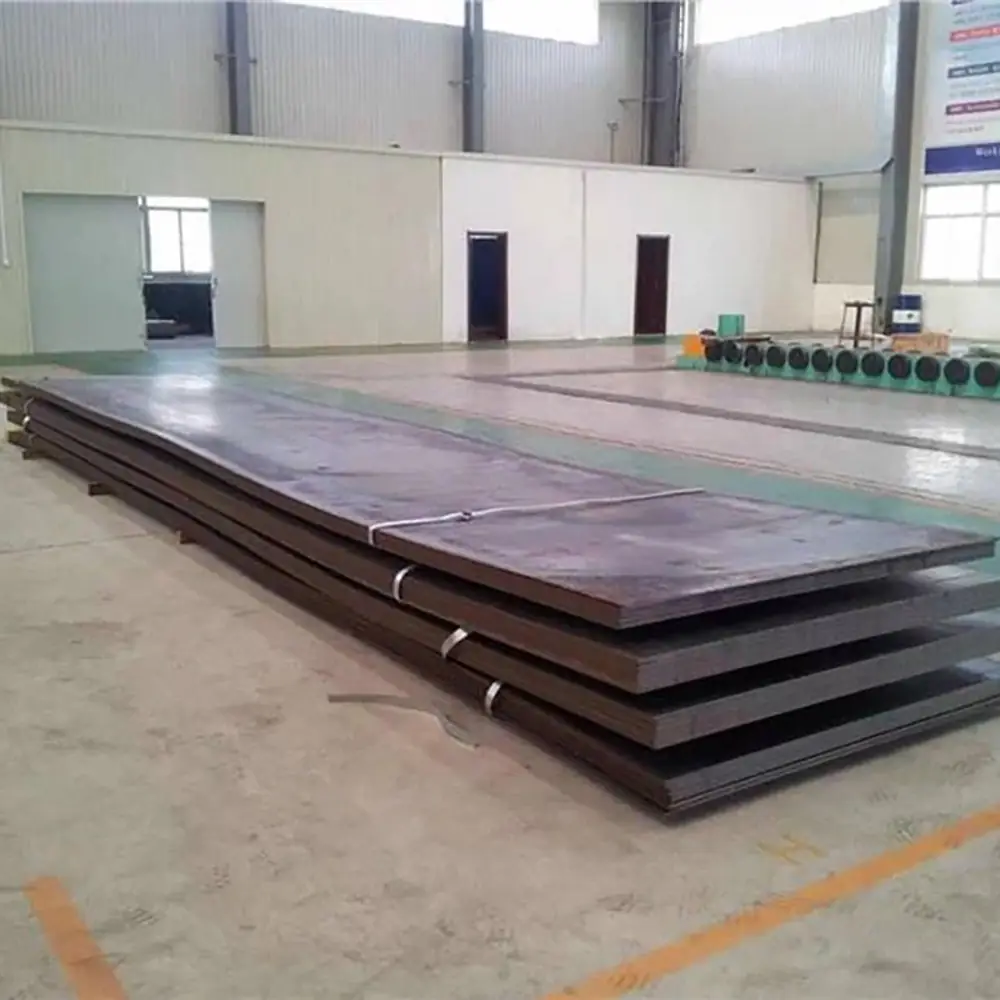
A Range of Grades for Different Hull Requirements
Runfei Group can discuss normal-strength and higher-strength plate requirements across different grade levels. Buyers should provide the grade specified in the drawings rather than selecting a substitute based only on yield strength. The required classification society and certification scope should also be stated in the inquiry.
Plate Dimensions for Fabrication Planning
Plate thickness, width, and length should be confirmed before production. Customized lengths can help reduce unnecessary cutting, but the final dimensions must match the approved nesting plan and fabrication drawings. Buyers should also identify any special flatness, edge, or dimensional requirements.
Processing Options for Different Components
Cutting, milling, grinding, and polishing may be arranged according to the component drawings and agreed scope. For parts requiring bevels, holes, or special profiles, buyers should submit dimensioned drawings and clarify the required tolerances. This helps prevent differences between the quoted scope and the finished parts.
Inspection and Surface Treatment Requirements
Inspection methods should be selected according to the purchase specification and applicable standards. Buyers can discuss X-ray inspection, manual ultrasonic inspection, surface inspection, and other agreed checks where relevant. Surface cleaning, blasting, and painting can also be considered when the order requires them. The exact inspection method, coverage, acceptance criteria, and documentation should be confirmed before production.
Frequently Asked Questions About Shipbuilding Steel
Which shipbuilding steel grades can buyers request?
Common options include A, B, D, and E normal-strength grades, as well as AH32/DH32/EH32, AH36/DH36/EH36, and AH40/DH40/EH40 higher-strength grades. Availability and certification depend on the specific order and approval scope.
Can shipbuilding steel plates be supplied with classification certificates?
Certification requirements should be confirmed before ordering. Buyers should identify the required classification society and check that the certificate covers the manufacturer, grade, product type, and thickness range. The delivered plates must also be traceable to the relevant test documents.
Can plates be cut to custom dimensions?
Customized cutting may be arranged according to the agreed processing scope. Buyers should provide drawings that show finished dimensions, tolerances, bevels, holes, and other machining details. These requirements should be confirmed before production.
Is EH36 always a better choice than AH36?
No. EH36 has a more demanding impact-test temperature requirement than AH36, but the correct grade depends on the design temperature, structural location, and classification rules. The design specification should determine the grade.
What information should be included in a shipbuilding steel quotation request?
Provide the grade, applicable standard, thickness, width, length, quantity, delivery condition, required classification society, inspection scope, and destination. Include drawings or technical specifications when processing or special tolerances are required.
Conclusion
Choosing suitable hull steel requires more than comparing grade numbers or yield strength. Buyers should confirm impact toughness, weldability, dimensions, delivery condition, classification approval, and traceability before accepting a shipment.
Runfei Group can discuss shipbuilding steel plate requirements based on the buyer’s technical specification. To request a quotation, send the required grade, thickness, width, length, quantity, classification society, delivery condition, and inspection requirements. Drawings and material specifications will help clarify the supply and processing scope before the order is confirmed.