Key Takeaways
- SPCC is the JIS G3141 commercial-quality cold rolled grade, and the second C is the part buyers forget: it caps how far the steel can be formed.
- The same grade ships in two finishes. Bright and dull behave differently under paint and under handling.
- Thickness tolerance is written one-sided or two-sided, and the two notations describe very different usable ranges at the same nominal gauge.
- Annealing route never appears in the grade name, yet it explains most cases of a part that formed well last month and cracked this month.
- Four checks at unloading settle most claims before the coil reaches the press: thickness, camber, edge, condensation rust.
What SPCC Steel Actually Specifies
SPCC steel reads as four abbreviations stacked together. S stands for steel, P for plate or sheet, the first C for cold rolled, and the second C for commercial quality. The full designation belongs to JIS G3141, the Japanese standard for cold rolled carbon sheet and strip, and that standard is the reason the grade travels so well. Mills in China, Korea, Taiwan and Southeast Asia roll to it, traders quote it, and a buyer in Jeddah or Lagos can name it without opening a reference book.
The last letter deserves more attention than it usually gets. Commercial quality means the steel is meant for parts that bend, punch and roll form without severe stretching. It is not a promise of deep drawability, and it says nothing about surface finish, edge condition, annealing route or tolerance band. Those four items are ordered separately, and that is where most of the surprises live.
The Ladder Above and Below It
JIS G3141 is a ladder, and SPCC sits on its lowest rung. Each step up buys formability with strength and money, and the jump from SPCC to SPCD steel is the one most orders genuinely need.
| Grade | Forming class | Nearest EN 10130 grade | Typical part | Common misuse |
| SPCC | Commercial | DC01 | Appliance side panels, shelving, cable trunking, painted substrate | Ordered for a draw that needs SPCD |
| SPCD | Drawing | DC03 | Office equipment frames, furniture brackets, moderate draws | Bought as insurance where one bend is all that happens |
| SPCE | Deep drawing | DC04 | Sinks, deep housings, motor covers | Specified without checking whether the die suits softer strip |
| SPCF | Deep drawing, severe | DC05 | Complex automotive panels, curved housings | Treated as a drop-in replacement for SPCE |
| SPCG | Extra deep drawing | DC06 | Oil pans, intricate enclosures | Expected to fix a die problem that is really a lubrication problem |
The right-hand column is the expensive one. Over-specifying looks safe and is not: a softer strip dents more easily, carries less load and costs more per tonne, so a part that only bends once ends up weaker and dearer than it needed to be.
Why Carbon Drops as the Draw Gets Deeper
As the ladder climbs, the carbon ceiling falls. SPCC allows roughly 0.15 percent carbon, SPCD steel holds it near 0.10, and SPCE steel near 0.08. Lower carbon gives a softer strip, less springback after forming and a wider margin before an edge tears.
The trade is real. Softer steel dents, scratches and buckles more readily, and it costs more. The useful question is not which grade is better in the abstract, but how much stretch the part demands at its tightest radius. Answer that honestly and the grade usually picks itself.
Two Ways the Same Grade Goes Wrong
Chemistry is fixed by the grade. Two other variables are not, and both get decided when the order is placed rather than when the coil is cut.
Bright Finish, Wrong Paint Line
Cold rolled strip leaves the mill with a surface finish code, and SPCC carries two of them. SB is bright: rolled against polished rolls, low in roughness, with a sheen that photographs well. SD is dull: a matte grey produced by a textured roll, with a profile that holds paint.
For a part that will be painted, SD is usually the better buy. The rougher surface gives pretreatment and primer something to grip, and it hides the faint marks a press leaves behind. Bright strip needs a cleaner, more disciplined pretreatment to reach the same adhesion, and any handling scratch stays visible. For a cover panel left unpainted, bright looks like a finished product while dull can read as unfinished, though only if the batch is consistent, since dull finishes show patchiness badly when coils come from different rolls.
The price gap between them is small. The mistake is not the money, it is buying bright to look premium and then watching the paint fail a cross-hatch test.
Two Coils, Different Behaviour
Annealing is where the grade name goes quiet. Two routes produce SPCC, and they leave the strip in different states. Batch annealing stacks coils in a furnace for a cycle measured in days. Continuous annealing runs the strip through a line in minutes, with tighter control of temperature and cooling.
Continuous annealing tends to give better flatness and closer coil-to-coil consistency. Batch annealing suits smaller lots and heavier gauges, and it can reach the softer tempers that deep drawing wants, but the coil in the middle of a stack may not match the coil at the edge.
In a press shop the difference shows up as springback. A die tuned on one batch bends a part to ninety degrees; the next batch springs back to ninety-three. The part that passed last month now fails, and nothing on the certificate changed, because the certificate reports chemistry rather than annealing history. The practical fix costs nothing: name the route on the purchase order and keep one route per part.
Tolerance, Edge and What to Check on Arrival
Tolerance is the part of a cold rolled steel order that gets the least attention and causes the most arguments, usually three months later when a die stops closing properly.
Reading a Thickness Tolerance
A thickness callout has two halves: the nominal gauge and the band around it. The band can be written symmetrically or on one side, and the two are not interchangeable.
Take 0.50 mm nominal. A two-sided callout of plus or minus 0.05 mm accepts anything from 0.45 to 0.55. A one-sided callout of plus zero, minus 0.02 mm accepts 0.48 to 0.50. Same nominal figure, roughly a fifth of the usable range, and the second one sits entirely at or below nominal.
Which suits you depends on the tool. A press set to nominal with a fixed gap prefers strip that never runs heavy, so a minus-only band protects the die. A process that compensates by shimming wants the wider band and the lower price that comes with it.
Where the reading is taken matters too. Strip runs thinner near the edge, so a measurement two millimetres in from a trimmed edge is not the thickness of the coil. Read across the width, at the head and at the tail, and write the measuring position into the order so both sides judge the same point.
Mill Edge, Trimmed Edge, Camber
Edge condition is the second thing the grade leaves open. A mill edge is as rolled: slightly rounded, sometimes wavy, and prone to hairline cracks that open up when the strip is formed. A trimmed edge has been cut, so it is straight and square, which matters for automatic feeding and for any part where the edge stays visible.
Camber is the lateral bow in a coil. It appears as a strip that curves away from a straight line when unrolled on the floor, and it turns serious once the coil is slit into narrow widths, because slitting multiplies the deviation across every strand. Suppliers quote camber as millimetres of deviation over a stated length, so two coils can both be “in tolerance” while one is three times straighter than the other.
The Four Checks Before You Sign
Unload, then inspect in this order. Each check is cheap now and expensive after the coil reaches the press.
- Thickness: read across the width at head and tail, not once in the middle of the coil.
- Camber: pull a string along two metres of unrolled strip and measure the widest gap.
- Edge: look for cracks, burrs and a slitting burr standing proud, and check the coil for telescoping.
- Wrap and rust: open the wrap at the coil eye and at the outer lap, where container condensation leaves its marks.
If the first coil fails, stop unloading. A claim is much harder to win once the first coil has been cut.
Where SPCC Earns Its Place
SPCC steel covers a wide band of everyday sheet metal work, and most of it never asks the material to do anything difficult.
- Appliance cabinets, side panels and white goods wrap
- Office equipment frames, shelving and racking
- Metal furniture, display stands and shop fittings
- Door skins, cable trunking and ventilation ducting
- Painted substrate for general fabrication and enclosures
- Control cabinets and electrical boxes, powder coated after forming
Gauge is usually chosen for stiffness rather than strength. A panel that oil-cans at 0.6 mm will not be rescued by a stronger grade at 0.5 mm, because deflection follows thickness far more closely than it follows yield. Where a part feels flimsy the answer is a heavier sheet. A duller finish hides dents; it does not prevent them.
It is the wrong choice for three jobs: draws that stretch beyond its carbon ceiling, structural members carrying calculated loads, and any part left unpainted outdoors. In each case a different grade does the work better, and forcing SPCC into them shows up later as cracks, deflection or rust.
SPCC Coil and Sheet From Runfei
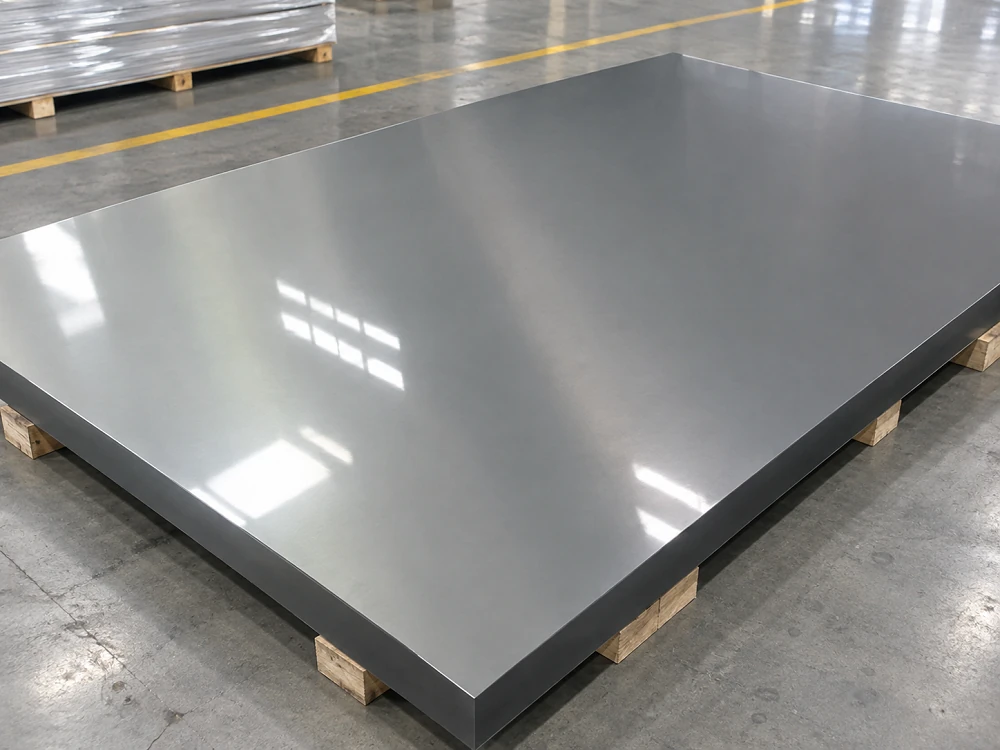
Runfei supplies SPCC cold rolled coil and sheet from Tianjin, in commercial quality, cut to length or slit to width before it ships.
Thickness, Width and How It Ships Cut
Stock runs from 0.40 mm to 2.0 mm in thickness and 610 mm to 1250 mm in width. Thickness is held to plus zero, minus 0.02 mm, while width and length run to plus 5, minus 0 mm. A coil carries up to 5 metric tonnes, the minimum order is 25 tonnes, and shipment follows within 20 to 25 days from any Chinese port.
Buyers can take coils whole, slit to the width their roll former needs, or cut to length as flat sheets. Slitting to the finished width takes a cut off your own line along with the scrap that goes with it.
Packing That Survives the Voyage
Standard sea packing uses a moisture barrier, edge protection and steel strapping, with the coil eye horizontal or vertical depending on how the container is loaded. The wrap matters more than it looks. Condensation inside a container is the usual cause of rust found at destination, and a coil that arrives spotted has already lost the clean surface that painting depends on.
Runfei works to ISO 9001, and independent inspection can be arranged before loading when a buyer’s own quality team wants a second opinion on the coil.
Frequently Asked Questions
Is SPCC the same as DC01?
Close, but not the same document. DC01 belongs to EN 10130 while SPCC belongs to JIS G3141. The chemistry windows overlap and plenty of fabricators treat them as interchangeable, yet a drawing that names DC01 will be judged against EN limits, and a mill certificate written to JIS may not carry the values an EN inspector looks for. Where the drawing is explicit, order to the standard it names.
What does SPCC-SD mean?
The suffix describes the surface finish. SD is dull, produced with a textured roll; SB is bright. Neither changes chemistry or strength, but both change how the strip takes paint and how it looks on a finished part. An order that names only SPCC leaves the mill free to ship either one.
Can SPCC be painted without pretreatment?
No. Strip arrives with a rolling oil film and a thin oxide layer, and paint applied over them fails at the interface. Degreasing followed by a conversion coating gives the adhesion a bend test will accept. Bright strip needs the more careful version of that preparation, which is the hidden cost of choosing it for a painted part.
What thickness tolerance should I put on a cold rolled coil order?
Start from the die. If it is set to nominal with a fixed gap, a one-sided minus band protects it. If the process adjusts, a two-sided band is cheaper and easier to source. Ask what the mill can actually hold before writing a band tighter than the line can deliver, and state the measuring position so both sides judge the same point.
Can SPCC be welded?
Yes, and it welds easily at these gauges. Resistance spot welding, seam welding and ordinary arc welding all work on strip between 0.4 mm and 2.0 mm. Distortion is the real risk on thin sheet, so keep heat input low and spread the weld sequence out. None of this makes SPCC a structural grade.
Conclusion
SPCC is one of the most widely used cold rolled grades in the world. Most of the trouble around it comes from the parts the name leaves out: which finish, which tolerance band, which annealing route, and what the coil looked like when the wrap came off. Put those four items in writing, check them at unloading, and the rest of the process runs on the strip you thought you bought.
Send the part drawing, the finish you need and your annual tonnage. Runfei will confirm grade, tolerance and packing before the first coil leaves Tianjin.